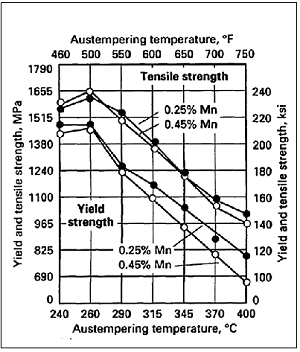
The austempering temperature is the primary determinant of the final microstructure and therefore the hardness and strength of the austempered ductile iron product. As the austempering temperature increases, the strength varies, as shown in Fig. 19 for irons with two levels of manganese.
The attainment of maximum ductility at any given austempering temperature is a sensitive function of time. The initial increase in elongation occurs as stage I, and elongation progresses to completion, at which point the fraction of austenite is a maximum.
Further austempering merely serves to reduce ductility, as the stage II reaction causes decomposition to the equilibrium bainite product. Typical austempering times vary from one to four hours.
Adapted from: K. Hayrynen, Heat Treating and Properties of Ductile Iron, Heat Treating of Irons and Steels, Vol 4D, ASM Handbook, ASM International, 2014, p 508–521. https://doi.org/10.31399/asm.hb.v04d.a0005937
For more information on this topic, visit the article (subscription required), scroll down the Chapter Contents column on the left, and click on Austempering Ductile Iron.