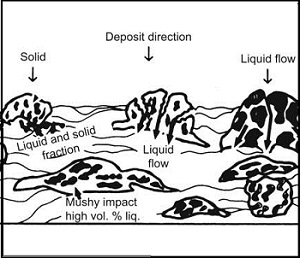
The most common source of coating porosity is trapped, unmelted, or resolidified particles. The figure shows particle impact states that create structural features. Depending on the particle temperatures, the arriving droplets may cover the full range of liquid to solid states.
The liquid-state particles flow easily and fill most voids, as illustrated in Fig. 7 shown. Solid particles, some of which are reflected from the solid surface, may adhere locally to, or become trapped in, the rough finish of the coatings. These “overspray” particles are not well bonded, nor are they in intimate contact with the underlying splat, which creates voids that are not open to direct line-of-sight.
As stated before, thermal spray is a line-of-sight process; hence, the next arriving particles cannot fill voids adjacent to trapped solid particles. This is shown in Fig. 7. In other cases, even in the same instant, some solid + liquid (i.e., partially molten) particles may deform and be completely densified, provided sufficient liquid is available to fill any voids that form around the small amount of existing solid core. It is also possible that partially melted particles act similarly to solid particles, leaving trapped voids around their solid portions.
This information is from ASM Handbooks Online, Vol. 5A Thermal Spray Technology, Coating Structures, Properties, and Materials. To find this information, click on the link below and scroll down to Fig. 7.