The 52100 steel is considered a low-alloy steel with modest hardenability, and the fine grain size due to aluminum carbonitride particles imparts increased toughness. However, the fine grain size also reduces hardenability.
The maximum section thickness of 52100 that can be fully hardened is about 19 mm (0.75 in.). If the maximum section size of a bearing is larger than this, or if the volume of work being quenched exceeds the heat extraction capacity of the quench, or if the transfer time from furnace to the quench is too long, then a slack quench condition occurs. This results in the formation of nonmartensitic transformation products (also known as dark etching constituent, slow quench product, and upper bainite). These appear as a distinct, dark constituent dispersed in the martensitic matrix.
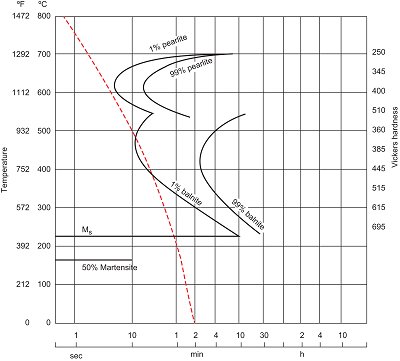
The time temperature transformation (TTT) diagram for 52100 (Fig. 7) shows that a workpiece must be quenched rapidly to miss the bainite “nose” and avoid the formation of nonmartensitic transformation products in the martensitic matrix. Workpiece temperature must be below 450°C (840°F) in less than 10 seconds to preclude bainite nucleation and growth.
The dashed line in Fig. 7 represents a slack quench cooling rate that intersects the bainite nose. A rule of thumb is that if the hardness of an as-quenched sample is below 63 HRC, the presence of nonmartensitic transformation product or some other furnace issue is likely.
The graph shows the Time-Temperature-Transformation (TTT) diagram for 52100, austenitized at 860°C (1580°F) for ten minutes. The dashed line simulates a workload slack-quenched from the austenitizing temperature, intersecting the Bainite-start nose of the curve before reaching the martensite start (Ms) temperature, where it quenches to room temperature. The microstructure will contain a small amount of bainite in a martensitic matrix.
For more information, click on the link below (subscription required), then scroll down the Chapter Contents on the left of the page, and click on Quench problems that can affect through-hardening bearing steels.
https://dl.asminternational.org/handbooks/book/9/chapter/110017/Heat-Treatment-of-Bearings