Induction heating is used for through hardening, for secondary hardening of carburized parts, for tempering, for preparation of surface material to modify outcomes of subsequent heat treatment, and for other purposes.
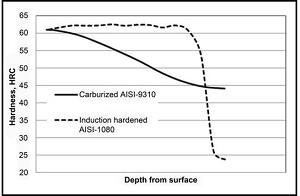
In addition to induction, flame, laser, and electron beam are used for surface hardening. However, with some exceptions, surface hardening of chemically homogeneous steel most often is associated with induction hardening (and vice versa) in bearing manufacture. Therefore, although somewhat anomalous as a “common heat treat process” mentioned previously, this combination of method and process constitutes an alternative that is worth specific discussion.
Compared with the use of furnaces for chemical diffusion, surface induction hardening offers improved energy efficiency and usually a smaller equipment footprint. Processing time can be dramatically shortened: single-shot cycles that energize the entire surface using encircling coils can heat parts in seconds.
By selecting frequencies and power, designing coils to tailor the electromagnetic field, and controlling quenching rates and direction, specific zones can be hardened with adjacent material remaining unaffected, obviating the need for masking or subsequent hardened layer removal. The process provides one-piece product flow, and heating is confined to the individual component, permitting integration with manufacturing lines in a way that is difficult to arrange using other equipment.
For more information, click on the link below (subscription required). Then scroll down the Chapter Contents column on the left of the page, and click on “Surface Induction Hardening.”
https://dl.asminternational.org/handbooks/book/9/chapter/110017/Heat-Treatment-of-Bearings