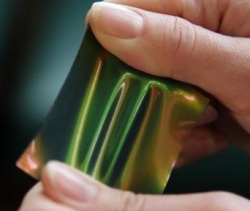
A synthetic material that mimics the brightest and most vivid colors in nature and changes color when twisted or stretched was developed by researchers at the University of Cambridge, UK. It could have important applications in the security, textile, and sensing industries.
Instead of through pigments, these “polymer opals” get their color from their internal structure alone, resulting in pure color which does not run or fade. The materials could be used to replace the toxic dyes used in the textile industry, or as a security application, making paper money harder to forge. Additionally, the thin, flexible material changes color when force is exerted on it, which could have potential use in sensing applications by indicating the amount of strain placed on the material.
The most intense colors in nature-such as those in butterfly wings, peacock feathers and opals-result from structural color. While most of nature gets its color through pigments, items displaying structural color reflect light very strongly at certain wavelengths, resulting in colors which do not fade over time.
In collaboration with the DKI (now Fraunhofer Institute for Structural Durability and System Reliability), Germany, researchers from the University of Cambridge developed a synthetic material which has the same intensity of color as a hard opal, but in a thin, flexible film.
Naturally-occurring opals are formed of silica spheres suspended in water. As the water evaporates, the spheres settle into layers, resulting in a hard, shiny stone. The polymer opals are formed using a similar principle, but instead of silica, they are constructed of spherical nanoparticles bonded to a rubber-like outer shell. When the nanoparticles are bent around a curve, they are pushed into the correct position to make structural color possible. The shell material forms an elastic matrix and the hard spheres become ordered into a durable, impact-resistant photonic crystal.
“Unlike natural opals, which appear multi-colored as a result of silica spheres not settling in identical layers, the polymer opals consist of one preferred layer structure and so have a uniform color,” said Professor Jeremy Baumberg of the Nanophotonics Group at the University’s Cavendish Laboratory, who is leading the development of the material.
Like natural opals, the internal structure of polymer opals causes diffraction of light, resulting in strong structural color. The exact color of the material is determined by the size of the spheres. And since the material has a rubbery consistency, when it is twisted and stretched, the spacing between spheres changes, changing the color of the material. When stretched, the material shifts into the blue range of the spectrum, and when compressed, the color shifts towards red. When released, the material will return to its original color.
The material could be used in security printing in order to detect fraud. Polymer opals can produce much brighter color at lower cost than the holograms normally seen on banknotes, and would be more difficult to forge.
The technology could also have important uses in the textile industry. “The World Bank estimates that between 17 and 20% of industrial waste water comes from the textile industry, which uses highly toxic chemicals to produce color,” said Professor Baumberg. “So other avenues to make color is something worth exploring.” The polymer opals can be bonded to a polyurethane layer and then onto any fabric. The material can be cut, laminated, welded, stitched, etched, embossed and perforated.
The researchers have recently developed a new method of constructing the material, which offers localized control and potentially different colors in the same material by creating the structure only over defined areas. In the new work, electric fields in a print head are used to line the nanoparticles up forming the opal, and are fixed in position with UV light. The researchers have shown that different colors can be printed from a single ink by changing this electric field strength to change the lattice spacing.
More information:
Fraunhofer Institute for Structural Durability and System Reliability