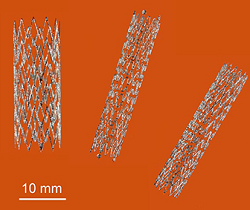
The Lab22 Innovation Centre within Australia’s Commonwealth Scientific and Industrial Research Organisation (CSIRO), Melbourne, reports that it has produced the world’s first customized additively manufactured Nitinol self-expanding stents for people with peripheral arterial disease (PAD).
PAD is a progressive disease caused by the buildup of plaque in the arterial system that carries blood to the arms, legs, and vital organs. Approximately 10% of the world’s population is believed to have PAD, and endovascular stenting is commonly used in PAD patients because it is minimally invasive and enables shorter recovery times.
The CSIRO team has been exploring the feasibility of additive manufacturing Nitinol self-expanding stents using Laser Powder Bed Fusion (L-PBF). However, this process has challenges when developing a nitinol stent.
The L-PBF parameters for building the stent had to be suitably selected to fabricate the ultra-fine mesh structure of the stents, comprising fine struts of 80 to 200 µm in size. They also needed to be fine-tuned so that the desired phase transformation temperature of less than 37°C, could be achieved in the finished stent.
According to CSIRO, using additive manufacturing technologies, clinically certified custom-made additively manufactured nitinol self-expanding stents can potentially be manufactured on-site within medical institutions, under the surgeon’s direction. The design freedoms offered by AM not only allow for the customization of these stents to the specific size of a patient’s vessel proximal and distal diameters, but also can accommodate larger-size stents, cross branches, and new shapes for proximal and distal vessels.
Additively manufactured nitinol stents thus offer the potential for customization, inventory reduction (less inventory on the shelf), and resource efficiencies. For the patient, these special stents reportedly provide a better fitting device, better conformity to blood vessels, and improved recovery time – equating to an improved patient experience.