When parts come in for repair, the surface is usually damaged due to wear and/or corrosion. Repair procedures call for removal of the damaged surface material by undercutting into the substrate.
Undercutting removes some good material as well as the damaged surface in order to provide a uniform flat surface to accept the new coating. It is important to remember that undercutting reduces the cross-sectional area and correspondingly reduces the tensile and ultimate strength of the part being restored.
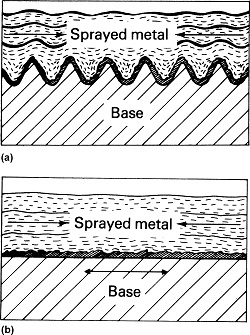
Sprayed coatings will not restore the original tensile strength, even though the cross-sectional area will have been restored. The undercut surface area can be prepared by grit blasting, macroroughening, or bond coating, depending on the depth of undercut and the coating material chosen for spraying. It is important to reiterate that macroroughening can reduce fatigue life as well as the strength of the part.
Image – Comparison of thermal spray coatings deposited on macroroughened and smooth surfaces. (a) Sprayed metal over grooves; shrinkage constrained by grooves. (b) Sprayed metal on smooth surface; effect of shear stress on bond due to shrinkage. Adapted from T.F.Bernecki, Ed., Thermal Spray Coatings: Properties, Processes and Applications, Proc. Fourth National Thermal Spray Conf., May 4–10, 1991 (Pittsburgh, PA), ASM International, 1992.
This information is from ASM Handbooks Online, Vol. 5A: Thermal Spray Technology, Coating Structures, Properties, and Materials. To find this information (subscription required), click on the link below and scroll down to Figure 9.