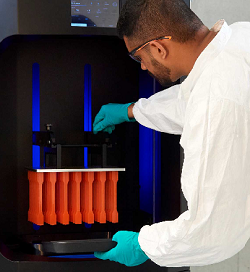
The BMW Group, Munich, has officially opened its new Additive Manufacturing Campus, which brings together production of prototype and series parts under one roof, along with research into new 3D printing technologies, and associate training for the global rollout of tool-less production.
The campus, built with an investment of about $17 million, will allow the BMW Group to develop its position as technology leader in the utilization of additive manufacturing in the automotive industry.
Last year, the BMW Group produced about 300,000 parts by additive manufacturing. The Additive Manufacturing Campus currently employs up to 80 associates and operates about 50 industrial systems that work with metals and plastics. Another 50 systems are in operation at production sites around the world.
In 2016, BMW i Ventures – the venture capital arm of the BMW Group – invested in the Silicon Valley-based company Carbon, whose DLS (digital light synthesis) technology achieved a breakthrough in planar processes, using a planar light projector to enable super-fast component production.
Further investments were made in 2017, when the BMW Group became involved with Desktop Metal, a start-up specializing in additive manufacturing of metal components and developing innovative, highly productive manufacturing procedures. Close collaborations with Desktop Metal continue. In the same year, BMW i Ventures invested in the U.S. startup Xometry, the world’s leading platform for on-demand manufacturing. With its extensive network of manufacturing companies specializing in fields such as 3D printing, Xometry provides fast access to components.
The latest investment was in the German start-up ELISE, which allows engineers to produce component DNA containing all the technical requirements for the part, from load requirements and manufacturing restrictions to costs and potential optimisation parameters. ELISE then uses this DNA, along with established development tools, to automatically generate optimum components.