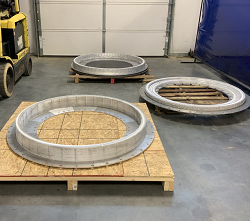
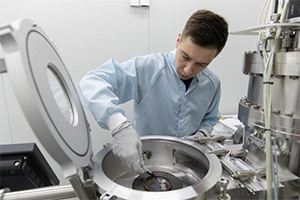
Meld Manufacturing Corp., Christiansburg, Va., announces that it has 3D-printed aluminum components greater than 55 inches in diameter in off-the-shelf aluminum 6061 by using its open-air solid-state printer.
Components have solid walls, some over four inches thick. The size of the components is a milestone for the company and represents the advantages the open-air printer offers in scalability. The Al 6061 alloy is notable, because despite its widespread utilization in industry, it is not compatible with other metal additive technologies. However, with the Meld technology, large structures typically produced via forging, can now be printed on demand.
Meld’s solid-state process is based on heating metals through a combination of high forces and friction just to the point that they flow freely and are able to be combined, or “Melded” with one another. The metal behaves almost like a thick, viscous liquid, but it is not a liquid. In this special plastic state, the metal is still a solid. That is what makes Meld unique.
Meld is the first process that can build 3D parts in the solid state. No melting means it is possible to make products that rival or beat parts made with traditional subtractive machining, all in one step.
Meld is an open-atmosphere process, and does not need to be contained. Melt-based processes generally either have a container to hold metal powder, or operate in a chamber that prevents oxygen from getting in while the laser is running. Either way, these containers automatically limit part size.
Meld can also make parts rapidly. The company says the process deposits material at least ten times faster than fusion-based metal-additive processes. Furthermore, Meld is not limited in the metal alloys that can be deposited. From aluminum to titanium and steel to nickel-base superalloys, Meld is can create high-quality parts using the same machine and the same process.