Researchers at the Harvard John A. Paulson School of Engineering and Applied Sciences (SEAS). have developed a system to mold near-field light—opening the door to unprecedented control over this powerful, largely unexplored type of light, which could aid advances in high resolution microscopy, particle manipulations, and more.
Today, near-field light is mostly used for ultra-high-resolution microscopy, known as the near-field scanning optical microscopes (NSOM). However, near-field light also has untapped potential for particle manipulation, sensing, and optical communications. But since near-field light doesn’t reach our eyes like far-field light does, researchers, until now, have not developed a comprehensive toolkit to harness and manipulate the near field.
“Today, we have a lot of tools and techniques to design what far-field light looks like,” said Vincent Ginis, a visiting professor SEAS. “We have lenses, telescopes, prisms and holograms. All these things enable us to sculpt freely propagating light in space.”
“Over the years, our group has developed new powerful techniques to structure propagating light using subwavelength-patterned metasurfaces,” said Federico Capasso, the Robert Wallace Professor of Applied Physics and Vinton Hayes Senior Research Fellow in Electrical Engineering, and senior author of the paper published in Science. “With this work, we show how to structure the near field at a distance, opening exciting opportunities in science and technology.”
In order to manipulate near-field light, the researchers developed a device in which light confined to a waveguide bounces back and forth between two reflectors. After each bounce it changes mode, meaning it propagates with a different spatial pattern. With multiple bounces, these patterns add up to generate a complex light intensity profile along the waveguide. The near field light near the surface of the waveguide also changes. When all the different patterns of the near-field light are superimposed on each other, a specific shape is created. The researchers can pre-program that shape by tailoring the amplitude of the modes of the bouncing light.
“The coexistence of all these modes can be designed to create near-field landscapes at will on the surface of the device,” said Marco Piccardo, a research associate at SEAS and co-author of the paper. “The shape of the landscape is determined by the combined properties of the cascading light.”
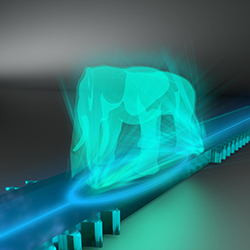
To demonstrate their design, the researchers molded near-field light into the shape of an elephant. Or, more specifically, an elephant inside a boa constrictor, an homage to the play on dimensions in Antoine de Saint-Exupéry’s classic The Little Prince.
The researchers also shaped the light into a curve, a plateau and a straight line.
“This research provides a new path towards unprecedented three-dimensional control of near-field light,” said Capasso. “It is a portent of the exciting discoveries and technology developments I expect to come out of this work in the future.”
************
Image – Designer landscape of localized light in the shape of an elephant. Guided light is molded by bouncing back and forth between two mode converters. Courtesy of Second Bay Studios/Harvard SEAS.
For more information:
Harvard John A. Paulson School of Engineering and Applied Sciences