Bainitic and martensitic microstructures in direct heat treated (DHT) steels are transformed by faster cooling directly after hot forging. The strength of bainitic microalloyed steel is improved by small additions of alloying elements such as molybdenum and boron and higher cooling rates after forging.
With air cooling at a rate of less than 10,000 K/s, a bainitic structure can be produced. This higher-strength microstructure makes it possible to reduce the weight of automotive components. By selection of optimized cooling directly after forging, strength levels of up to 1200 MPa (174 ksi) have been developed and used for crankshafts, knuckle spindles, and joint yokes. Bainitic steel with high strength and toughness has been developed for use in lower arms of automotive suspensions.
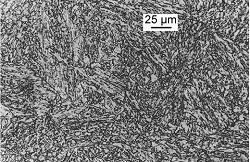
The strength and mechanical properties of the steel are comparable to those of traditional quenched and tempered SAE 5140. The 900 MPa (130.5 ksi) grade high-strength microalloyed steel achieves its bainitic microstructure by direct aging after hot forging. This direct heat treatment method results in a lower arm without the dimensional deformation usually associated with quenching and tempering operations. The figure shows the microstructure of bainitic microalloyed steel.
For more information, click on the link below (subscription required). Then scroll to Figure 21.
H. Tahira, K. Funatani, Forge and Direct Heat Treatment Processes and Technologies, Heat Treating of Irons and Steels, Vol 4D, ASM Handbook, Edited By Jon L. Dossett, George E. Totten, ASM International, 2014, p 241-252, https://doi.org/10.31399/asm.hb.v04d.a0005994