Researchers at Lehigh University (Bethlehem, Pa.) are transforming an aberration-corrected scanning transmission electron microscope (STEM) into the equivalent of a synchrotron facility (a football-field-size particle accelerator), with greatly improved spatial resolution and versatility.
This upgraded instrumentation system, which integrates an electron energy loss spectrometer (EELS) into the aberration-corrected STEM (an approximately 3-meter-tall instrument, located on the first floor of Whitaker Laboratory) would expand scientists’ ability to characterize the chemical composition and bonding status of elements within a material down to the single-atom level, says Masashi Watanabe, an associate professor of materials science and engineering in the P.C. Rossin College of Engineering and Applied Science at Lehigh University.
“Even at the national labs’ powerful synchrotron facilities, there is no instrument available that can get this high spatial-resolution information, this level of detail at the nanoscale, that we’re targeting,” says Watanabe.
“That’s why, with a successful prototype of this novel EELS system that meets our goal of increasing spatial resolution by 1000 times over current integrations, we see important applications in areas like semiconductors, advanced alloys, and catalysis–and the potential for an overall paradigm shift.”
It’s an advance, he says, that could usher in a new era in materials characterization.
The Lehigh team began partnering with Japanese electron microscope manufacturer JEOL and German electron optics company CEOS to create the prototype, back in December 2020. It will include an EELS spectrometer with improved optics design for the detection of higher energy-loss electrons and an ultra-high sensitivity electron detector for limited signal detection in the high-energy-loss range.
The project was recently awarded a three-year, $625,000 grant from the National Science Foundation’s Major Research Instrumentation Program, which supports the development of next-generation research instruments and the creation of new opportunities for scientific and engineering discovery and collaboration.
Watanabe is leading the system’s development. Fellow materials science and engineering faculty members Helen Chan, Himanshu Jain, John DuPont, and Christopher Kiely are also on the project and will test the instrumentation in their various research areas. The proposal was coordinated through Lehigh’s Institute for Functional Materials and Devices (I-FMD).
“We’ll be able to expand the materials we can investigate through EELS analysis to include, for example, gold nanoparticles in catalytic applications, high entropy alloys with heavy elements, and rare-earth based LEDs, among other applications,” Watanabe says.
“It will give Lehigh a unique capability in materials characterization research and give researchers an alternative to traveling to a national synchrotron lab. We’re also advancing the educational mission of the Lehigh Microscopy School in training scientists and engineers from other institutions on new technology and ways to acquire data.”
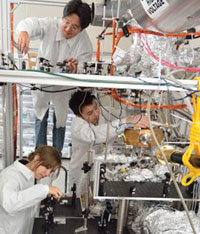
Image – Dr. Masashi Watanabe is an associate professor of materials science and engineering in the P.C. Rossin College of Engineering and Applied Science at Lehigh University in Bethlehem, Pa.
************
For more information: