Scientists at Fraunhofer IWS Dresden, Germany, have developed a cost-effective HICLAD process to maximize corrosion and wear protection that also reduces particulate emissions. This is important as brake discs are moving into focus as part of current green-energy discussions.
Laser powder cladding is one of the well-established industrial coating processes for protecting high-quality components against corrosion and wear due to its coating properties and diverse material spectrums.
However, for mass production in large quantities, such as brake discs, conventional laser cladding only partially meets industrial cost targets. As a result, Fraunhofer IWS has now developed high performance and high-speed laser cladding HICLAD.
“This new process uses specially developed powder nozzles and optics configurations,” explains Holger Hillig, manager of Fraunhofer’s Laser Cladding System Technology group. This approach designs a stable and reproducible high-performance coating process with up to 20 kilowatts of laser power. “Productivity and job performance increase accordingly, both of which are indispensable for series production,” he says.
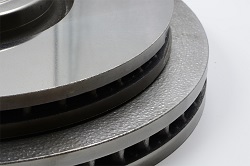
The brake discs are coated in two layers: a corrosion protection layer of about 125 micrometers thick is created from stainless steel. The HICLAD process is adjusted in such a way that a defect-free coating is formed on the difficult-to-weld lamellar grey cast iron of the brake disc blanks, which has minimal values in terms of mixing, stresses and distortion.
On top, a welding layer with the actual tribological function is applied. It obtains its wear resistance from hard materials such as tungsten carbide, titanium carbide, or chromium carbide embedded in an iron-based alloy.
The coating system and the mixing ratios are adjusted to achieve an optimal friction pairing when combined with the brake pads in terms of braking properties and minimal fine dust emissions.
Thanks to process control and melt pool monitoring, the process is robust, so, for example, inexpensive powders with a broader particle size distribution can also be used, which significantly reduces the overall material costs.
The quality of the coating system can be controlled non-destructively using LAwave technology. The coating significantly reduces fine dust emissions during braking and avoids corrosion damage that usually occurs during irregular use – such as in electric vehicles. It also considerably extends the service life of the treated brake discs.
Image – HICLAD is a cost-effective coating solution for tailoring of brake disc’s corrosion resistance, friction behavior, and reduced particulate emissions (bottom: as-clad condition; top: finish grinded condition) Courtesy of Fraunhofer IWS Dresden.
For more information:
Fraunhofer IWS Dresden
https://www.iws.fraunhofer.de/en