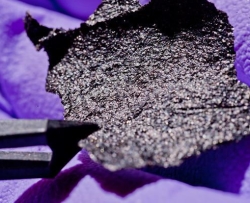
Researchers at the University of California Riverside, and the University of Manchester, U.K., report that that a sandwich made of graphene on both sides of a sheet of copper improves the copper’s ability to dissipate heat by 25%. The graphene itself does not conduct the heat away. Rather, it alters the structure of the copper, improving its conductive properties.
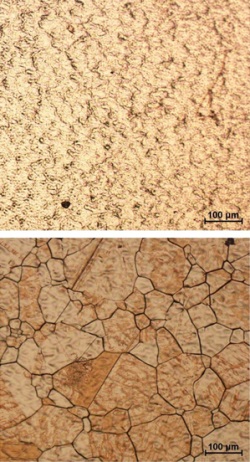
Heat moving through copper is usually slowed by the crystalline structure of the metal. Graphene changes this structure, causing those walls to move farther apart, and allowing heat to flow more readily. Studies were done with relatively thick sheets of copper—much larger than the copper wires found in computer chips—but researchers expect that the heat-conducting effect will be seen in thinner copper wires, too.
This year, Intel is expected to announce products containing 14-nanometer transistors, with copper interconnects about on this scale or even smaller. Copper wires will not work below 10 nanometers, and it’s not clear what will. “We haven’t yet found an interconnect material that can work beyond 10 nanometers,” partly due to overheating, says Saroj Nayak, a physicist at the Center for Integrated Electronics at the Rensselaer Polytechnic Institute in Troy, New York.
It’s clear that simply cramming more transistors into processors and putting more processors in chips is not going to be tenable much longer. High-end chips already contain about 50 to 60 kilometers of copper wiring and multiple cores.