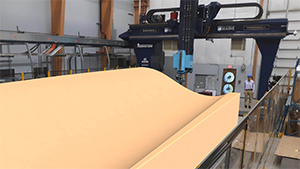
The University of Maine Advanced Structures and Composites Center has been awarded $2.8 million from the U.S. Department of Energy Office of Energy Efficiency and Renewable Energy to develop a rapid, low-cost additive manufacturing solution for fabricating large, segmented wind blade molds. It will do so by using Ingersoll‘s giant composites 3D printer, which the university already successfully implemented in previous projects, including 3D printing of a full-size boat.
In addition, the UMaine Composites Center will collaborate on a $4 million award to Oak Ridge National Laboratory (ORNL) to apply robotic deposition of continuous reinforcing fibers in wind blades.
UMaine is a world leader in cellulose nanofiber (CNF) technology, including the development of nano- and micro-cellulose reinforced thermoplastic composites. These new bio-based materials promise mechanical properties like aluminum at lower fabricated costs. Carbon fiber reinforced ABS thermoplastic feedstocks, which are widely used in large-scale 3D printing, cost more than $5 per pound. By incorporating bio-based materials derived from wood, the cost of the feedstock can be reduced to less than $2 per pound.
The molds will incorporate 3D printed heating elements using a new technology developed at ORNL. Control of mold surface temperatures is a critical mold manufacturing requirement, and the new ORNL technology enables robotic deposition of heating elements, reducing mold fabrication time and cost.
The outcome of the proposed research is to transform mold production as a key enabler for more rapid and more cost-effective large wind turbine blade development. TPI Composites and Siemens Gamesa (SGRE) are partnering with the UMaine Composites Center on the project. A successful demonstration will put both SGRE and TPI in a position to transition the additive manufacturing solution into practice.
For more information: The University of Maine