Researchers at Northwestern Polytechnical University, China, the National Center for Nanoscience and Technology, China, and other Chinese institutes introduced a new design strategy to create transistors and logic circuits with tunable electrical conductivity based on metal nanoparticles.
These transistors, presented in the paper Transistors and logic circuits based on metal nanoparticles and ionic gradients, published in Nature Electronics, achieved remarkable results both in terms of efficiency and electrical conductivity.
Transistors can be fabricated using a variety of inorganic and organic semiconducting materials. Metals are generally considered unsuitable because they screen electric fields making it difficult to create devices with tunable electrical conductivity. A possible way to create electronic components based on metals is to use gradients of counter ions in films of metal nanoparticles functionalized with charged organic ligands.
In the past, engineers have successfully used this strategy to create a variety of devices, ranging from resistors to diodes and sensors. Nonetheless, modulating the electrical conductivity of these devices has often proved to be challenging.
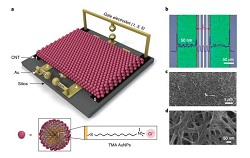
“We show that transistors and logic circuits can be created from thin films of functionalized gold nanoparticles using dynamic ionic gradients established via an unconventional five-electrode configuration,” the researchers wrote in their paper. “The transistors are capable of a 400-fold modulation of electrical conductivity and by combining them with metal nanoparticle diodes and resistors, can be used to construct NOT, NAND and NOR logic gates, as well as a half-adder circuit.”
Past studies have shown that logic circuits made of metal nanoparticles are significantly slower than silicon-based devices. Nonetheless, they also have a number of advantageous characteristics. For instance, they can operate in humid/wet environments and they are fairly flexible and can endure electrostatic discharges which can damage silicon-based devices.
In initial evaluations, the new transistor performed remarkably well. In addition to having a tunable electrical conductivity, the transistor can withstand electrostatic discharges, and continues operating well when it is deposited on flexible substrates and these structures are stretched or deformed.
Image – Schematic and experimental images outlining the design of the metal nanoparticle film-based transistor created by the researchers. Courtesy of Zhao, et al.
For more information:
Northwestern Polytechnical University
https://en.nwpu.edu.cn/
National Center for Nanoscience and Technology
http://english.nanoctr.cas.cn/