As with all coating technologies, thermal spray has some limitations. Understanding these limitations is important so that engineers can design effective solutions to the challenges of surface modification. Failures have occurred because coating and substrate limitations were not considered or were poorly understood.
Thermal spray coatings generally exhibit some porosity, allowing the passage of gases and/or liquids through to the coating/substrate interface. Porosity is controllable down to levels below approximately 0.1% with most processes.
Post deposition treatments such as fusion, sintering, or hot isostatic pressing can decrease porosity and close up splat boundaries. Surface and interconnected porosity can be closed off using a variety of sealing methods, including anaerobic sealers, epoxies, phenolic sealers, and so on. Connected porosity is minimized by ng high-velocity oxyfuel, VPS, and cold spray processes.
Thermal spray coatings are inherently anisotropic in the as-sprayed condition. That issue is discussed elsewhere in this Volume.
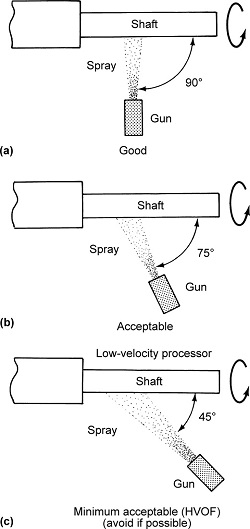
Thermal spray deposition of coatings on simple geometrical configurations is relatively straightforward. Complex geometries, such as gas-turbine airfoils, require automated, robotically-controlled manipulation of the gun and/or substrate to properly address the coating surface. Deviation from spraying normal to the surface can compromise coating properties (Fig. 3a). As a rule of thumb, low-velocity spray processes need to stay within ±15° of normal (Fig. 3b). Higher-velocity processes can tolerate off-axis spraying up to ±45° (Fig. 3b). Porosity tends to increase and coating cohesion tends to decrease, along with deposit efficiency, beyond these limits.
Image – Fig. 3 Thermal spray stream positions. (a) Good. (b) Acceptable. (c) Minimum acceptable (high-velocity oxyfuel).
This information is from ASM Handbooks Online, Vol. 5A: Thermal Spray Technology, Coating Structures, Properties, and Materials. To find this information (subscription required), click on the link below and scroll down to Figure 3.