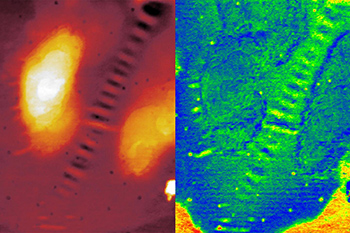
The morphology of bitumen surfaces has been identified in the past by atomic force microscopy and scanning electron microscopy. But what still remained a mystery was whether its surface and chemical compositions correlate with each other. Now materials chemists Dr. Ayse Koyun and Prof. Hinrich Grothe from TU Wien, Vienna, have examined the bitumen surface using various physicochemical analysis methods and learned more about how to decelerate the oxidation process thus, slowing the aging of the material.
Bitumen is produced from petroleum and primarily used for the production of asphalt. The oxidation process that accelerates the aging of the material causes the bitumen to become porous, and damage develops.
Since asphalt and bitumen are used for road construction as well as for waterproofing work, the longest possible product lifetime is desirable. To slow down the aging of the material, reactions triggered by reactive gasses, light and heat must be minimized. In a study published in Colloids and Surfaces A: Physicochemical and Engineering Aspects, Koyun has already been able to show how the chemical composition of bitumen affects its aging process. Her newest research was published in the data in the journal Scientific Reports.
In close collaboration with Harvard University, Bruker Nano-Surfaces Division as well as IONTOF GmbH, Ayse Koyun, first author of the study, investigated the bitumen surface using three different methods: nanoscale infrared spectroscopy based on photothermal expansion (AFM-IR), time-of-flight secondary ion mass spectrometry (ToF-SIMS) and fluorescence microscopy. In combination, these methods provide valuable insights into the multiphase nature of the bitumen surface. “The resolution of conventional measurement methods used to study surface composition is too low for chemical characterization. Individual domains of the surface cannot be determined in this way,” Koyun explains. “However, by combining different physicochemical methods, we succeed in mapping the structure down to ten nanometers.” The result: the surface is heterogeneous. The findings of microscopic and spectroscopic methods correlate and can be interpreted conclusively.
“For a long time, bitumen was like an unsolved puzzle for us materials chemists,” says Hinrich Grothe, head of the Physical Chemistry of the Atmosphere research group. “We know many details, but until now it has not been possible to piece them together into a complete picture. However, the combination of several physicochemical methods, as we applied them, was finally able to show us how the individual molecular assemblies are distributed in the bitumen.” “This allowed us to solve the puzzle and complete our knowledge of bitumen,” adds Ayse Koyun, who is completing two research stays at Harvard University as part of a Marshall Scholarship and with support from the TU Wien.
Image – Bitumen surface imaged with two different microscopic techniques. Left: AFM (topography image). Right: AFM-IR (chemical distribution – IR absorption at 1262 cm-1). Courtesy of TU Wien.
************
For more information: