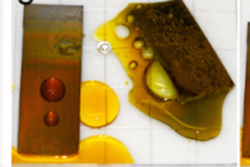
The heat released at the part surfaces affects porosity in many ways. Surface porosity increases the roughness which slows down the speed of the cooling medium that is removing heat from the part surfaces. The suction effect exerted by the hot gas present inside porosity contracts itself during cooling, which suctions the vapor bubbles originating from the quenching liquid.
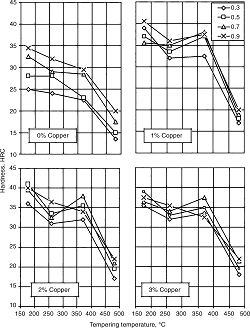
The porosity in most compacts is not uniform. This is particularly important on the upper and lower faces that were in contact with the press punches. On these faces, porosity is higher at the surface in press and sinter parts. The figure below illustrates this effect for a F-0000 compact, which had either admixed lubricant or the die wall was lubricated. Overall porosity is approximately 8.5% but increases to almost 15% within 0.2 mm (0.008 in.) of the surface. This creates a higher degree of open porosity on these surfaces. While the effect of porosity on measured hardness (apparent hardness) is easy to visualize, it is hard to take into account. Hardness deviations from expected values caused by porosity increase with decreasing density. The relation is generally exponential but varies with the pore shape and dimensions, which change with processing and starting powder.
For more information, click on the link below (subscription required). Then scroll to Figure 7.
Joseph W. Newkirk, Heat Treatment of Powder Metallurgy Steels, Heat Treating of Irons and Steels, Vol 4D, ASM Handbook, Edited By Jon L. Dossett, George E. Totten, ASM International, 2014, p 253-273, https://doi.org/10.31399/asm.hb.v04d.9781627081689.