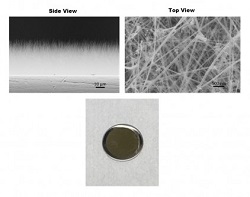
A new type of material based on nanoporous copper foams using metallic nanowires as building blocks has promising applications in filtration media, smart masks, and air cleaners. In this digital-first article from Advanced Materials & Processes, ASM International’s flagship magazine, a team from Georgetown University shares the science behind their metal foam discovery.
In addition, based on their research, some members of the team submitted an entry that was among the Top 10 finalists in the Phase 1 of a Mask Innovation Challenge conducted by the Biomedical Advanced Research and Development Authority and the National Institute for Occupational Safety and Health. Read the full digital-first article, which will also be published in the September 2021 issue of Advanced Materials & Processes (AM&P) magazine.
This article is the eleventh installment in an AM&P series on materials science and the coronavirus.
READ THE DIGITAL FIRST ARTICLE
About the Authors
James Malloy—Department of Physics, Georgetown University, Washington and Department of Physics, University of California, Davis
Alberto Quintana—Department of Physics, Georgetown University, Washington
Christopher J. Jensen—Department of Physics, Georgetown University, Washington
Kai Liu—Department of Physics, Georgetown University, Washington and Department of Physics, University of California, Davis
************
About ASM International
ASM International is a member-driven organization that serves the information needs of scientists, engineers, and technicians who develop, test, select, and apply advanced materials, including metals, composites, polymers, and ceramics. As the world’s largest and most established materials information society, ASM engages and connects members to a global network of peers and provides access to trusted materials information through reference content and data, education courses, international events, and applied research.
To learn more about ASM International, visit asminternational.org or call 440.671.3800 to speak with an ASM International representative.
Image–Lightweight copper foam sample sites on the bristles of a plant.
************
For more information:
Prof. Kai Liu
Previous articles in the Materials Science and the Coronavirus Series:
Can Copper Help Fight COVID-19?
Copper’s Conductivity and Antimicrobial Properties Inspire Renewed Interest
Antimicrobial Copper-Containing Stainless Steels Show Promise
Using Digitally Distributed Manufacturing to Address Critical Needs
Development and Validation of High-Performance SARS-CoV-2 Antiviral Coatings for High-Touch Surfaces
Supersonically Deposited Antiviral Copper Coatings
Optimizing 3D-Printed, Reusable Metal N95 Filters by 3D Characterization and Modeling
EPA Officially Says Copper Surfaces Help Fight COVID-19
The Pact Between Preservation and Ruin
Measuring Virus Infectivity on Material Surfaces
************
Subject Classifications
Materials Properties and Performance | Environmental Impacts
Materials Properties and Performance | Mechanical Properties
Materials Testing and Evaluation | Materials Characterization
Materials Testing and Evaluation | Metallography and Microstructures
Metals and Alloys | Copper