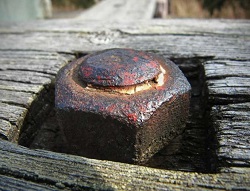
Researchers at Cornell University, Ithaca, N.Y., used advanced atomic modeling to explore the ways environment can influence the growth of cracks in alloys such as aluminum and steel and found when it comes to the integrity of structural alloys, a little corrosion may sometimes be a good thing.
By removing atoms from the tip of a crack, the modeling showed the researchers could prevent a crack from propagating, essentially improving the material’s mechanical performance. This could help engineers better predict, and possibly postpone, the failure of structures.
“People have been modeling crack growth and fracture for a long time, but the actual process by which it occurs has not really been clear, at least for structural alloys in complicated environments,” said Derek Warner, associate professor of civil and environmental engineering and senior author of the work published in Physical Review Letters. “It can be a very large-scale phenomenon—big structures can fracture—but it can be controlled at the atomic scale, particularly when you look at environmental effects.”
An environment has many different mechanisms that adversely impact a material, like dissolution, oxide formation, material redeposition, and hydrogen embrittlement. Warner and his team in the Cornell Fracture Group focused on dissolution, which can be found everywhere from corroded metal surfaces to eroded human bone.
The team created a series of atomic 2D models of a structural alloy, similar to aluminum and steel, that was ductile—i.e., pliable enough that it that wouldn’t shatter when deformed, as glass does.
By running numerous simulations that stressed the material with a range of loading cycles, the researchers were able to see the different ways the atoms interacted. The researchers then began removing loosely bonded atoms from the surface, one at a time, and monitored the crack’s behavior.
They found that removing surface material inhibited the crack from growing.
“The proclivity of a crack to grow depends on how sharp it is,” Warner said. “If you have a big round notch, it’s unlikely to propagate like a crack. But if you have some sharp feature, like a slit cut with a knife, it is more likely to grow. So in this way, material removal, akin to what occurs during corrosion, can actually improve mechanical performance.”
The research is of particular interest for the Office of Naval Research, which funded the study, and its efforts to keep expensive aircraft in safe working condition amid the extreme ocean environment.
Image – Courtesy of: CC0 Public Domain
For more information:
Cornell University
www.cornell.edu