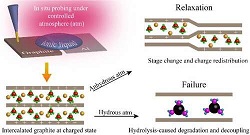
A research team at the Dalian Institute of Chemical Physics at the Chinese Academy of Sciences, China, revealed the atmosphere-dependent relaxation and failure mechanisms of energy storage devices (ESDs) by in situ surface science methodology.
Since long cycle life and high safety are required in large-scale ESD applications, it’s important to explore their operating and failure mechanisms. Previous characterization techniques such as x-ray diffraction, transmission electron microscopy, x-ray spectroscopy and topography, and nuclear magnetic resonance were based on bulk regions of electrodes or electrolytes, and they overlooked the critical surface/interface behaviors that govern the operation and failure in ESDs.
The current research, published in Journal of the American Chemical Society, visualized atmosphere-dependent relaxation and failure processes in ESDs by in situ Raman, XRD and x-ray photoelectron spectroscopy.
It found that for aluminum ion batteries, relaxation effects of graphite electrodes in anhydrous atmospheres were manifested by recoverable stage-structure change and electronic relaxation. The mechanism could be described as the redistribution of the anion/cation pairs within graphite electrode by in situ XPS.
Once exposed to hydrous atmospheres, ambient H2O molecules could intercalate into the graphite electrode and forming hydrolysis reactions between the newly intercalated H2O and ions. After H2O intercalation and hydrolysis, graphite electrode failures by stage-structure degradation and electronic decoupling occurred.
“We have developed the atmosphere-, temperature- and potential-controlled operando/in situ surface/interface techniques and well-defined model devices,” said Prof. Fu. “Such methods can be extended to explore the relaxation and failure mechanisms of more ESDs, such as metal-ion secondary batteries/supercapacitors, and the interface reactions in metal-gas batteries.”
For more information:
Chinese Academy of Sciences