The spray-pattern phenomena described here apply to all thermal spray processes. Variables common to each process, such as total gas flow, energy levels, particle size distribution, specific gravity, and carrier gas flow, combine to affect time, temperature, and mass. These in turn affect porosity, unmelted particles, and oxides quantitatively. The spray pattern varies between processes more as a function of gas stream velocity.
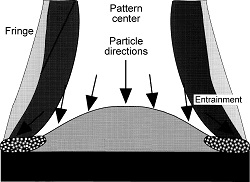
The image depicts the spray pattern in cross section. In a planar view, parallel to the substrate, the spray pattern of the spray stream is circular or oval in shape. The deposit at an instant in time is essentially Gaussian in cross section, where, at the center, the highest degree of melting has occurred. Moving radially out from the center, temperatures and velocities are lower, resulting in slightly different microstructures. Each particle will have a unique time/temperature/velocity profile as it passes through the plume or jet.
By maintaining tight control of the feedstock and parameters, the stream can produce a statistically significant number of properly melted and accelerated particles.
Image – The spray pattern, illustrating particle deposition and the effect of size and debris on thickness and porosity in cross section
This information is from ASM Handbooks Online, Vol. 5A: Thermal Spray Technology, Coating Structures, Properties, and Materials. To find this information (subscription required), click on the link below and scroll down to Figure 13.