Researchers at Lawrence Berkeley National Laboratory, UC Berkeley, Cornell, and Rutgers University have discovered layered 2D materials that can host unique magnetic features that remain stable at room temperature and could thus eventually be used in future everyday devices. Atomic-scale images of the material as reported in the journal Science Advances, reveal the precise chemical and structural characteristics that are responsible for these features and their stability.
Two-dimensional magnetic materials have been hailed as building blocks for the next generation of small, fast electronic devices. These materials, made of layers of crystalline sheets just a few atoms thick, gain their unique magnetic properties from the intrinsic compass-needle-like spins of their electrons. The sheets’ atomic-scale thinness means that these spins can be manipulated on the finest scales using external electric fields, potentially leading to novel low-energy data storage and information processing systems. But knowing exactly how to design 2D materials with specific magnetic properties that can be precisely manipulated remains a barrier to their application.
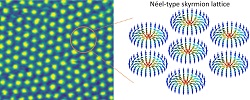
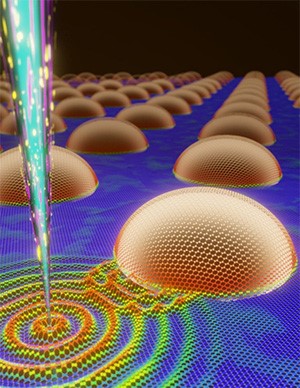
Berkeley Lab researchers have a track record of identifying unexpected magnetic properties in atomically thin layers of bulk crystals, many based on semiconductor materials doped with metal atoms. In this study, researchers calculated how the electronic structure of common 2D materials might change by swapping out different atoms, in this case some of the iron for cobalt. This particular swapping results in a crystal structure that cannot be superimposed on its mirror image, and leads to the possibility of exotic, vortex-like spin arrangements called skyrmions, which are being explored as building blocks of future low-power computing.
The researchers used crystal growth facilities at Berkeley Lab and UC Berkeley to explore some of the most promising 2D materials, including cobalt-doped iron germanium telluride (Fe5GeTe2) in the form of nanoflakes. Fe5GeTe2 is a typical 2D magnetic material owing to its unique layered structure and crystal symmetry, with iron atoms occupying specific points within the crystal structure.
They discovered that by replacing exactly half of the iron atoms with cobalt atoms – whose slightly different electronic configuration meant the atoms naturally occupied slightly different points in the crystal – they could spontaneously break the material’s natural crystal symmetry, which in turn altered its spin structure. It wasn’t easy to do. The structures took days or months to synthesize, and they went through hundreds of crystals.
The atomic-scale structure and electronic structure of the complex materials were confirmed using electron microscopy capabilities at the National Center for Electron Microscopy at the Molecular Foundry.
“This is pure discovery science and completely unexpected,” said Ramamoorthy Ramesh, a senior faculty scientist in Berkeley Lab’s Materials Sciences Division and the senior corresponding author on the paper. “The team was trying to manipulate electronic structure, and found that by breaking the symmetry, the material could host skyrmions.”
Zhang used magnetic force microscopy to image the skyrmions over large areas of such crystals. By following the evolution of the skyrmions as a function of temperature and magnetic field, the researchers established the physical conditions that led to their stability. Further, by passing an electric current across the material, the researchers found that they could cause the skyrmions to shift within the material, independently of the atoms that led to their formation in the first place.
Because the layered materials can be made with a wide range of thicknesses at room temperature and above, the researchers believe that their magnetic properties can be enhanced and expanded.
Image – A map produced by magnetic microscopy techniques shows vortex-like spin patterns called skyrmions appearing in a thin, layered 2D material. Berkeley Lab researchers say the material could advance smaller, faster, energy-efficient electronics such as low-power memory devices. Courtesy of: Berkeley Lab.
For more information:
Lawrence Berkeley National Laboratory
UC Berkeley