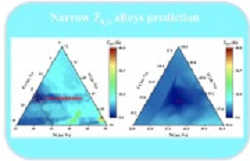
Harbin University of Science and Technology, China, has developed a new method to screen for shape memory alloys with narrow thermal hysteresis. This study analyzes multicomponent TiNi-based SMAs dataset by machine learning (ML) to explore new SMAs with narrow thermal hysteresis.
Shape memory alloys (SMAs) are desirable candidates for elastocaloric effect materials, but they all suffer from large thermal hysteresis (Thys).The second-largest eigenvalue λ2 of the stretch transformation matrix U is added to the original dataset to guide the ML process as a feature. Firstly, λ2 is obtained by first-principles calculations combined with ML. XGBoost Regressor (XGBR) combined with Leave-One-Out Cross-Validation (LOO-CV) is selected from four algorithms for modeling with the highest coefficient of determination R2 of 0.87.
The introduction of λ2 improves the performance of the model. The dataset is divided into 15 groups based on different doping elements (such as Hf, Cu, Zr, etc.), among which TiNiCu is the most predictive component with the R2 of 0.89. Over 500 TiNiCu components are randomly generated and predicted Thys. This not only provides a potential selection of narrow Thys TiNi-based SMAs but also indicates combining of XGBoost and DFT calculation is an effective strategy for materials design.
Read further here.