The controllable parameters for each of the major thermal process types are different, but all share some common fundamentals. Equipment and theory are covered extensively in the article “Thermal Spray Processes” in this Volume. It is important to be familiar with various equipment theory and parameter variations in order to understand the cause-and-effect relationship between parameters and sprayed coatings.
Converting feedstock material (whether powders, wires, or rods) into a coating requires both thermal energy for melting and gas flow for atomization and/or particle acceleration to propel the particles toward the substrate. The combination of available energy and jet velocity acting on the mass of the feedstock directly affects particle temperature, velocity, and trajectory.
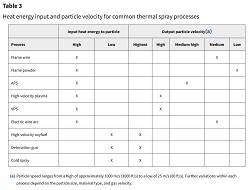
The table in the image compares thermal energy and particle velocity for each process. In general, powder- and wire-flame spray and electric-arc-sprayed coatings are generated from high heat input and low particle velocities. These coatings tend to exhibit higher oxide contents and higher porosity. Electric arc has a stronger potential to create fumes, where powder flame has a stronger tendency to produce unmelted particles in the coating. As a result of the higher particle velocity, particles present in plasma-sprayed coatings are flattened more than in flame-sprayed coatings. The resulting coatings are also denser, with finer porosity.
High-kinetic-energy processes such as detonation gun, HVOF, and cold spray produce very dense coatings with less embedded debris. In addition to the input spray parameters that control the spray pattern, particle heating and velocity, substrate temperature control, and torch-to-substrate relative motion are also critical for producing desired coatings.
Particle speed ranges from a high of approximately 1000 m/s (3000 ft/s) to a low of 25 m/s (80 ft/s). Further variations within each process depend on the particle size, material type, and gas velocity.
Image – Heat energy input and particle velocity for common thermal spray processes. (a) Particle speed ranges from a high of approximately 1000 m/s (3000 ft/s) to a low of 25 m/s (80 ft/s). Further variations within each process depend on the particle size, material type, and gas velocity.
This information is from ASM Handbooks Online, Vol. 5A: Thermal Spray Technology, Coating Structures, Properties, and Materials. To find this information (subscription required), click on the link below and scroll down to Table 3.
https://dl.asminternational.org/handbooks/book/12/chapter/134972/Introduction-to-Coating-Design-and-Processing