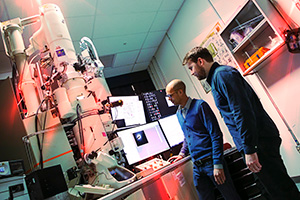
Based at Sandia National Laboratories, these scientists believe the key to preventing large-scale, catastrophic failures in bridges, airplanes, and power plants is to look very closely at damage as it first appears at the atomic and nanoscale levels.
“As humans, we see the physical space around us, and we imagine that everything is permanent,” Sandia materials scientist Brad Boyce said. “We see the table, the chair, the lamp, the lights, and we imagine it’s always going to be there, and it’s stable. But we also have this human experience that things around us can unexpectedly break. And that’s the evidence that these things aren’t really stable at all. The reality is many of the materials around us are unstable.”
But the ground truth about how failure begins atom by atom is largely a mystery, especially in complex, extreme environments like space, a fusion reactor or a nuclear power plant. The answer is obscured by complicated, interconnected processes that require a mix of specialized expertise to sort out.
The team recently published in the academic journal Science Advances research results on the destabilizing effects of radiation. While the findings describe how metals degrade from a fundamental perspective, the results could potentially help engineers predict a material’s response to different kinds of damage and improve the reliability of materials in intense radiation environments.
For instance, by the time a nuclear power plant reaches retirement age, pipes, cables, and containment systems inside the reactor can be dangerously brittle and weak. Decades of exposure to heat, stress, vibration, and a constant barrage of radiation break down materials faster than normal. Formerly strong structures become unreliable and unsafe, fit only for decontamination and disposal.
“If we can understand these mechanisms and make sure that future materials are, basically, adapted to minimize these degradation pathways, then perhaps we can get more life out of the materials that we rely on, or at least better anticipate when they’re going to fail so we can respond accordingly,” Boyce said.
The research was performed, in part, at the Center for Integrated Nanotechnologies, an Office of Science user facility operated for the Department of Energy by Sandia and Los Alamos national laboratories. It was funded by the DOE’s Basic Energy Sciences program.
For more information: Science Advances