Using ultra-fast laser pulses, a team of researchers led by University of Arizona (UA), Tucson, assistant professor Vanessa Huxter made the first detailed observation of how energy travels through diamonds containing nitrogen-vacancy centers-promising candidates for a variety of technological advances such as quantum computing.
The vacancy centers identified by Huxter’s team are defects in which two adjacent carbon atoms in the diamond’s crystal structure are replaced by a single nitrogen atom and an empty gap. These “flaws” result in unexpected and attractive properties that have put such diamonds in the spotlight as promising candidates for a variety of technological advances.
The findings, published online in Nature Physics, could help scientists better understand the properties of these diamonds, which have potential applications ranging from quantum computing to the imaging of individual atoms in molecules.
Defect centers are locations in the otherwise repetitive lattice of carbon atoms where other elements have taken the spot of carbon atoms. Such defects create, for example, canary diamonds in which nitrogen atoms have replaced carbon atoms. In the case of a nitrogen vacancy, a nitrogen atom sits next to an empty slot where a carbon atom is missing.
“Some of these defects have interesting optical and electronic properties,” said Huxter, who recently joined the UA’s Department of Chemistry and Biochemistry and led the research during a postdoctoral fellowship funded by the Natural Sciences and Engineering Research Council of Canada. Huxter did the research with co-authors Graham Fleming and Dmitry Budker at the U.S. Department of Energy’s Lawrence Berkeley National Laboratory and the University of California, Berkeley.
Huxter said because the nitrogen-vacancy defects can be manipulated with optical methods such as lasers, they could be used for computing, data storage, sensing and even advanced imaging techniques capable of revealing the structure of molecules.
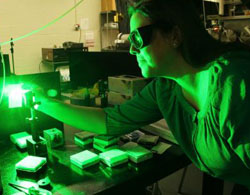
Image caption –Vanessa Huxter uses ultra-fast laser pulses to study physical processes in diamonds that happen on a time scale of a few nanoseconds-billionths of a second. Credit: Beatriz Verdugo/UANews
More information: