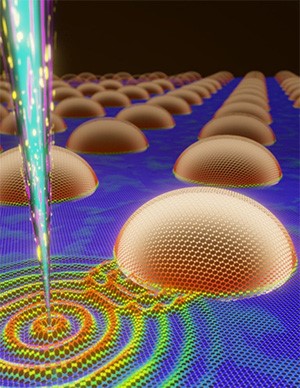
The Fraunhofer Institute for Solar Energy Systems, Germany, announces that it has joined forces with EV Group, Albany, N.Y., to develop equipment and process technology to enable electrically conductive and optically transparent direct wafer bonds at room temperature. Called ComBond, the goal of the technology is to bond highly mismatched material combinations such as gallium arsenide on silicon, GaAs on indium phosphide, InP on germanium, and GaAs on gallium antimonide, which can lead to new device architectures with unparalleled performance. Direct wafer bonding provides the ability to combine a variety of materials with optimal properties for integration into multi-junction solar cells.
“With direct semiconductor bond technology developed in cooperation with EVG, we expect that the best material choices for multi-junction solar cell devices will become available and allow us to increase the conversion efficiency toward 50%,” stated Dr. Frank Dimroth, head of department III-V – Epitaxy and Solar Cells of Fraunhofer ISE. “We are excited to partner with EVG, a leading supplier of wafer bonding equipment, to develop industrial tools and processes for this application.”
Fraunhofer ISE has developed III-V multi-junction solar cells for more than 20 years and has reached record device efficiencies of up to 41% with its metamorphic triple-junction solar cell technology on germanium. Higher efficiencies require the development of four- and five-junction solar cells with new material combinations to span the full absorption range of the sun’s spectrum between 300 and 2000 nm.
Integration of III-V solar cells on silicon opens another opportunity to reduce manufacturing cost, especially when combined with modern substrate lift-off technologies. Direct wafer-bonding is expected to play an important role in the development of next-generation III-V solar cell devices with applications in space as well as in terrestrial concentrator photovoltaics.