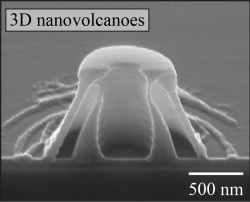
Researchers from North Carolina State University, Raleigh, developed a method for creating “nanovolcanoes” by shining various colors of light through a nanoscale “crystal ball” made of a synthetic polymer. These nanovolcanoes can store precise amounts of other materials and hold promise for new drug-delivery technologies.
The nanovolcanoes are created by placing spherical, transparent polymer nanoparticles directly onto the flat surface of a thin film. Ultraviolet light is shone through the transparent sphere, which scatters light and creates a pattern on the thin film. The thin film is made of a photoreactive material that undergoes a chemical change wherever it was struck by the light. The researchers then submerge the thin film in a liquid solution that washes away the parts of the film that were exposed to light. The material that remains is shaped like a nanoscale volcano.
“We can control the pattern of light by changing the diameter of the nanoparticle spheres, or by changing the wavelength-or color-of the light that we shine through the spheres,” says Xu Zhang, a doctoral student in mechanical and aerospace engineering at NC State. “That means we can control the shape and geometry of these structures, such as how big the cavity of the nanovolcano will be.”
Researchers developed a highly accurate computer model that predicts the shape and dimensions of the nanovolcanoes based on the diameter of the nanoscale sphere and the wavelength of light.
Because these structures have precisely measured hollow cores, and precisely measured openings at the “mouth” of the nanovolcanoes, they are good candidates for drug-delivery mechanisms. The size of the core allows users to control the amount of the drug a nanovolcano would store, while the size of the opening at the top of the nanovolcano could be used to regulate the drug’s release.
“The materials used in this process are relatively inexpensive, and the process can be easily scaled up,” says Dr. Chih-Hao Chang, an assistant professor of mechanical and aerospace engineering. “In addition, we can produce the nanovolcanoes in a uniformly patterned array, which may also be useful for controlling drug delivery.”
The team is working to improve its understanding of the release rate from the nanovolcanoes, such as how quickly nanoparticles of different sizes will “escape” from nanovolcanoes with different-sized mouths. “That’s essential information for drug-delivery applications,” Chang says.
“It is exciting to take our understanding of how light scatters by particles and apply it to nanolithography in order to come up with something that could actually help people.”
The paper, “Three-Dimensional Nanolithography Using Light Scattering from Colloidal Particles,” was published online June 12 in ACS Nano. Lead author of the paper is NC State Ph.D. student Xu Zhang. Co-authors are Chang and NC State master’s student Jonathan Elek. The research was supported by a NASA Early Career Faculty Award and the National Science Foundation’s ASSIST Engineering Research Center at NC State.
Image caption – Cross-section of a nanovolcano carved using light. Courtesy of Chih-Hao Chang.
More information: