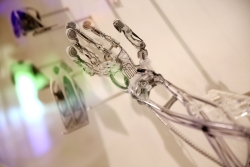
Student interns from the Additive Manufacturing and 3D Printing Research Group (3DPRG) at The University of Nottingham, UK, created a 3D-printed functionalized prosthetic arm illustrating how the technology could evolve to print customized prosthetics with electronic moving parts and nerve endings. The creation was present at 3D: printing the future, which opened at the London Science Museum in early October.
Professor Richard Hague, Professor of Innovative Manufacturing and leader of the research group, said the University was delighted to support the exhibition. The impact of additive manufacturing is rapidly growing. The wider availability of 3D printers and the prospect of goods being customized and printed at home or on the high street has further raised interest.
Suzy Antoniw of the Science Museum said: “We are indebted to Nottingham’s Additive Manufacturing and 3D Printing Research Group for all the support they have given to this exhibition. Prof. Hague and his team guided us through the complex, evolving field of additive manufacturing and provided valuable advice, fascinating insights and intriguing objects. The prototype prosthetic hand developed by Richard and his students (and showcased in the exhibition) is a prime example of how 3D-printed innovations could transform people’s lives.”
As well as the prosthetic arm created in Nottingham, the exhibition features 3D-printed pharmaceutical tablets, one of a number of collaborations between 3DPRG and the University’s School of Pharmacy. Some of the printed tablets are bilayered, allowing two different drugs to be released at varying speeds according to individual patient need.
Professor Clive Roberts, head of the School of Pharmacy, said 3D printing of solid medicines at point-of-care offers personalized patient treatments beyond the scope of conventional mass manufacturing. “While there are many practical and regulatory issues to consider I firmly believe that 3D printing will be used in the medicines manufactured in the future,” he added.
The Science Museum will also look at how engineers are using 3D printing to create lighter and more sustainable aerospace parts. This is being explored by Hague’s team and the University’s Institute for Aerospace Technology. Hague said additive manufacturing would help transform the industrial landscape, with more emphasis on smaller, localized manufacturing.
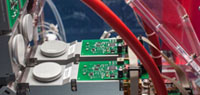
He said Nottingham is leading research into the next phase of Additive Manufacturing: the 3D printing of mixed materials in multifunctional devices. “At the moment 3D printing uses single materials, a polymer or a metal, which are fused together with a laser,” he said. “You can create interwoven geometries but they’re still passive. What we’re looking to do is activate those and make them functionalise. So rather than make a component you make the whole system – an example might be rather than print a case for a mobile phone you make the whole phone – all the electronics, the case, the structural aspects, all in one print.”
Hague added that a key strength of the research group was its close collaboration with colleagues working in the physical sciences at the University. The researchers were recently awarded a £2.7m grant from EPRSC (Engineering and Physical Sciences Research Council) to work with the School of Pharmacy, which is investigating functionalized drug delivery through the 3D printing of pharmaceuticals.
Another exciting development is new research into the direct 3D printing of metal. “That will be globally unique-nobody else will be working on that,” said Professor Hague. “We are working with an industrial partner to develop a system that jets metal. At the moment you can only jet nanoflakes of metal in a polymer ink.”
More information:
Additive Manufacturing and 3D Printing Research Group