A new technique uses neutron diffraction to measure several centimeters into the steel wheels of train carriages, which will help researchers investigate how train wheel cracks begin and spread. A study at the ENGIN-X instrument at the Science and Technology Facilities Council (STFC) Rutherford Appleton Laboratory in Oxfordshire, UK, is giving engineers the opportunity to test large and heavy components such as train wheels rather than small metal samples.
In everyday use, train wheels are subjected to stresses and strains that can cause cracks to develop, particularly in wheel rims. A group from the University of Huddersfield has been using ENGIN-X at the ISIS facility to study new and used train wheels to better understand how cracks begin and spread.
Train wheel manufacturing processes are designed to minimize the likelihood of cracks appearing. A heat treating process hardens the rim and puts it under compressive strain, making it difficult for cracks to start. However, some cracking is inevitable. When cracks have developed to a certain level, the wheel is put on a lathe to remove the outer layer and any cracks that have formed. This exposes the material underneath that is slightly less hardened, which can be more prone to cracking.
“We know that during operation, and during turning on the lathe, stresses within the wheel also change. We know that cracks grow more quickly toward the end of a wheel’s life, and this is true for various types of trains operating in different conditions. We wanted to know which was more important-the change in hardness or the change in residual stress,” says Adam Bevan, who led the study. “Hardness is easy to measure, but measuring the distribution of residual stress in the wheel is more difficult. Neutron diffraction allows us to measure several centimeters into the steel, and the big advantage of ENGIN-X at ISIS is the ability to test such large and heavy components.”
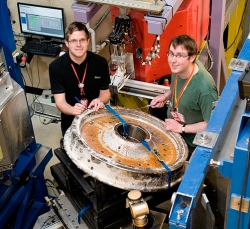
Image caption – Robert Jones and David Crosbee, Huddersfield University, use the ENGIN-X instrument to examine a train bogie wheel at the ISIS facility, STFC’s Rutherford Appleton Laboratory. Courtesy of STFC.
More information: