
A new U.S. National Science Foundation award will support Dr. Faiz Rahman and Dr. Savas Kaya in developing an advanced electron-beam lithography technique capable of creating features smaller than 5 nanometers. The three-year, $550,000 project runs from Sept. 1, 2026, through Aug. 31, 2029.
Electron-beam lithography is an important tool for fabricating extremely small customized structures, but producing features approaching molecular dimensions remains technically challenging.
The new project seeks to overcome these limits by combining a very fine electron beam with deep-ultraviolet radiation and singlet oxygen, a highly reactive form of oxygen. The electron beam breaks long polymer chains in the resist into smaller fragments, while singlet oxygen helps remove those fragments during patterning. This approach could allow extremely small openings to be produced directly in the resist in a single-step process.
The research aims to demonstrate patterning at the sub-5-nm scale, a capability increasingly important for semiconductor manufacturing and potentially valuable in photonics, bioengineering, nanomaterials and biomedical applications. The resulting nanoscale patterns could also be used as templates for removing or depositing materials and for fabricating photomasks needed for future generations of microelectronic devices.
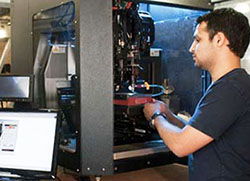
The work will be conducted at Ohio University’s Russ Research Opportunity Center (RROC) and will strengthen NQPI’s experimental capabilities in nanofabrication and nanoscale science.
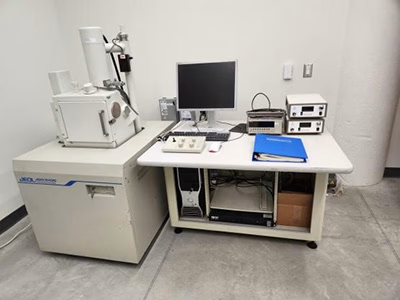
According to Rahman, an existing scanning electron microscope will be converted into an electron-beam lithography system for the project. The research will also provide training opportunities for postdoctoral and graduate researchers.
The award highlights the interdisciplinary strengths of NQPI and Ohio University in nanotechnology, advanced manufacturing, materials science and device fabrication, while establishing new capabilities for creating structures at dimensions of only a few nanometers.
For more information: National Science Foundation