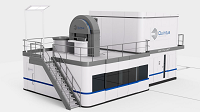
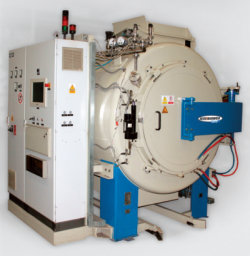
In the past, atmospheric furnaces were used quite often for heat treatment of tool steels. Due to the improved furnace technology of vacuum furnaces and their increased distribution in the market, the percentage of tools heat treated in atmospheric furnaces has fallen significantly over the last 20 to 30 years.
Furthermore, most of the atmospheric furnaces show a maximum temperature of 1100 °C (2000 °F). Therefore, the application of atmospheric furnaces is limited, with the maximum hardening temperature of the tool steel at or below 1050 °C (1925 °F).
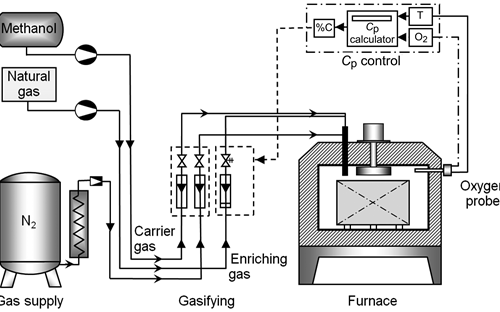
However, for atmospheric furnaces it is essential to select an atmosphere that will protect the surface of the tool steel against the addition or the depletion of carbon during heat treatment. Therefore, it is desirable to choose one that requires no adjustment of composition to suit various steels. Ammonia-based atmospheres meet this requirement due to the ammonia dissociation at high temperatures, leading to an excess of hydrogen with the advantage of a sufficient reduction of oxidation even of high-chromium steels.
For more information, click on the link below (subscription required). Then scroll to Figure 4.
R Schneider; R. Mesquita; W Schützenhöfer, Distortion in Tool Steels, ASM International, 2014, https://doi.org/10.31399/asm.hb.v04d.a0005958