The four primary conditions that may be controlled directly by the operator are inlet temperature, flow rate of liquid feed by adjusting the pump speed and pressure, air flow rate, and particle size by adjustment and design of the atomizer. Outlet temperature and the relative humidity of the outlet air are also important but can only be controlled indirectly through the adjustment of primary conditions.
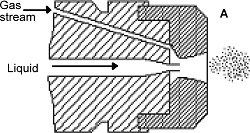
The cyclone spray dryer is the most commonly used spray drying equipment. Typically, a liquid product concentrate is pumped to the atomizing device (see image), where it is broken into small droplets. These droplets meet a stream of hot gas and lose moisture rapidly while suspended in the drying air. The dry powder is separated from the moist air in cyclones by centrifugal action. The atomizer comprises either a spinning disc (rotating at 2000 to 20,000 rpm) or static high-velocity jet nozzles.
Average operating conditions for spray drying vary depending on the application and on the dryer system used. These conditions must be adjusted to produce the desired uniform moisture content. The final moisture content and final particle size can be controlled by changing the operating conditions. Final moisture content is determined by the relative humidity of the outlet air, and if that value is too high, powder particles will absorb rather than lose moisture.
Image – Atomizing device in spray-drying system.
This information is from ASM Handbooks Online, Vol. 5A: Thermal Spray Technology, Coating Structures, Properties, and Materials. To find this information (subscription required), click on the link below and scroll down to Figure 9.
https://dl.asminternational.org/handbooks/edited-volume/12/chapter/133823/Feedstock-Material-Considerations-for-Thermal