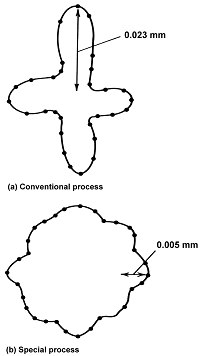
Controlling out-of-roundness is important for certain precision applications, such as class C and D cutting hobs made of high-speed steels. Class C and D hobs must be held close to size limits because they are not ground to size after heat treatment, but rather are used in the unground condition.
Normal size distortion in hardening and tempering can be accommodated by making the tool slightly oversize or slightly undersize, as required, before heat treating. High-speed steel bars, however, have been observed to go out-of-round as much as 0.05 mm (0.002 in.) during heat treatment. The pattern of size distortion shown in Fig. 8 can occur. It appears to be related to the initial shape of the cast ingot and to the specific primary-mill processing used to reduce the ingot into bars.
For more information, click on the link below (subscription required). Then scroll to Figure 8. R Schneider; R. Mesquita; W Schützenhöfer, Distortion in Tool Steels, ASM International, 2014 https://doi.org/10.31399/asm.hb.v04d.a0005980