A research team led by Tae-Woo Lee from Seoul National University’s Department of Materials Science and Engineering, in collaboration with Andrew M. Rappe from the University of Pennsylvania and Omer Yaffe from the Weizmann Institute of Science in Israel, has developed an ultra-high efficiency perovskite nanocrystal LED by strengthening the perovskite lattice and suppressing the material’s inherent low-frequency dynamics. Traditionally used in solar cells due to insufficient luminescence at room temperature, perovskites are composed of weak ionic bonds, and large-amplitude atomic displacements in their crystal lattices can cause dynamic disorder, which interferes with the radiative recombination process, leading to exciton dissociation and reduced luminescence efficiency.
Tae-Woo Lee recognized the potential of perovskite early on and secured several fundamental patents for perovskite light-emitting materials in 2014. Additionally, in 2015, his team published the first research paper demonstrating the enhancement of the efficiency in perovskite LED from 0.1 percent to 8.53 percent, comparable to the level of phosphorescent OLEDs.
In 2022, Lee’s team achieved an external quantum efficiency (EQE) of 28.9 percent (nearly theoretically achievable maximum), a peak brightness of 470,000 nits, and an operational lifetime of up to 30,000 hours. Moving towards commercialization, Lee’s startup company, SN Display, showed TV and tablet display prototypes at the CES (Consumer Electronics Show) in 2022 and 2023.
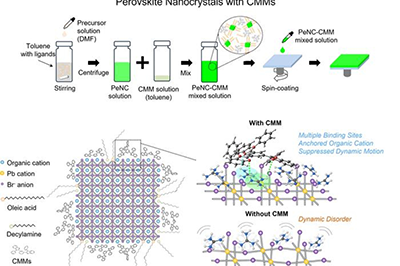
In this latest work, Lee and colleagues have focused on strategies to improve efficiency by reducing dynamic disorder using a novel mechanism that relies on conjugated molecular multipods (CMMs). When a CMM binds to the surface of the perovskite lattice, the lattice is strengthened, suppressing low-frequency dynamics and reducing dynamic disorder in the perovskite lattice. (Pictured above is a schematic diagram of the fabrication process).
The result is an ultra-high-efficiency LED with an EQE of 26.1 percent. This value is claimed to be among the highest efficiency in perovskite nanocrystal LEDs and is especially significant because the efficiency improvement was achieved by enhancing the intrinsic emission efficiency of the material itself rather than through engineering the device structure that enhances light outcoupling efficiency.
Lee commented: “This research presents a new material-based approach to overcoming the intrinsic limitations of perovskite light emitters. We anticipate that this will significantly contribute to the development of high-efficiency, long-lifetime perovskite light-emitting devices and the commercialization of next-generation displays.”
Rappe agreed, saying: “Together, we have shown the power of molecules in strengthening perovskites and making them better light emitters. By combining the powers of molecular chemistry, physics, mechanics, and optics, we are inventing new materials to lead us into a bright and energy-efficient future.”
For more information: Nature Communications
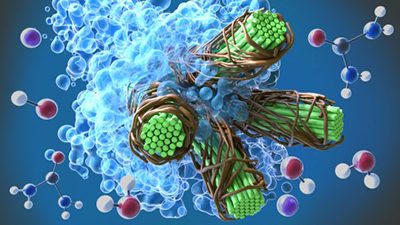
Image: Novel mechanism enhances luminescence efficiency by suppressing inherent low-frequency dynamics in the perovskite material.