Researchers at the University of Tokyo are breaking new ground being able to define which properties of concrete affect its structural characteristics under various neutron radiation loads.
Their findings raise some concerns while reducing others; for example, quartz crystals in concrete can heal themselves, potentially allowing some reactors to run for longer than initially thought possible.
One aspect of nuclear power stations that relates to safety and also longevity lies in the materials used in their construction; in particular, the concrete used throughout the buildings. But only now have researchers been able to explore in detail the way that neutron radiation from nuclear reactors can impact concrete’s longevity.
“Concrete is a composite material made up of multiple compounds. These can vary depending on various factors, including local geography, especially the rock aggregate which is a major component in concrete. But rock will often contain quartz. So, understanding how quartz changes under different radiation loads can help us predict how concrete should also behave in general,” said Professor Ippei Maruyama from the Department of Architecture.
“Neutron radiation-induced degradation is a particularly costly area of study, making extensive research difficult. Our research team has been addressing this issue since 2008, formulating strategies to solve the problem by consulting a wide range of literature and conducting interviews with experts. This culminated in our recent experiments using x-ray diffraction to look at irradiated quartz crystals.”
What they found was a little surprising at first. For a given total dosage of neutron radiation, the amount of expansion in a quartz crystal was far higher when the dose rate was higher, and vice versa.
“The discovery of the flux effect indicates not only that neutron radiation distorts the crystal structure, causing amorphization and expansion, but that there is also a phenomenon where the distorted crystals recover and the expansion diminishes, hence a lower rate affords more time to heal,” said Maruyama.
“We also saw this phenomenon depends on the size of the mineral crystals within concrete. Larger crystal grains exhibited less expansion, suggesting a size-dependent effect. Considering these findings, the degradation of concrete due to neutrons, which is currently a concern, may involve less expansion than previously thought.
“Consequently, degradation may be less severe than anticipated, potentially allowing nuclear power plants to operate more safely over longer periods.”
The research is published in the Journal of Nuclear Materials.
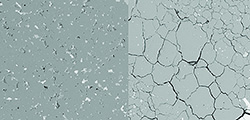
Image – Scanning electron microscope image of Metachert aggregate, a concrete analogue, before exposure to neutron radiation (left) and after (right). Courtesy of Journal of Nuclear Materials, 2025, doi.org/10.1016/j.jnucmat.2025.155631.
************
For more information:
University of Tokyo