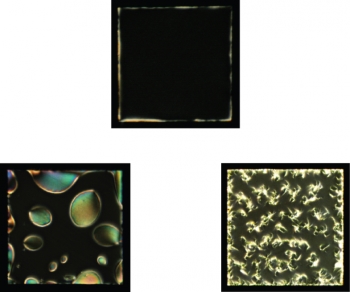
The observation of splats obtained after a few passes of the torch over the substrate placed at different distances from the liquid injection enables visualization of those areas where droplets formed after a breakup of the liquid jet injected into the plasma jet. Magnification of these areas revealed a fine microstructure, including individual small particles and, slightly greater, sintered agglomerates.
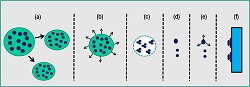
This observation enabled description of the behavior of a slurry droplet within the plasma, as displayed in the image. The mechanisms have been divided into six parts: (a) aerodynamic breakup, (b) evaporation of liquid, (c) sintering of fine solids, (d) melting of fine solids and of sintered agglomerates, (e) evaporation of liquid material, and (f) impact with the substrate.
The large droplets formed from the liquid jet by atomization are injected into the high-velocity plasma jet. The drag force between the droplet and the plasma creates shear deformation of the droplet. This can lead to the atomization of large droplets into smaller ones, depending on droplet size and surface tension. This phenomenon is called secondary breakup or aerodynamic breakup. The aerodynamic breakup occurs shortly after injection of large droplets (or primary atomization of liquid jet) in microseconds.
Image – Evolution of a suspension droplet in the high-temperature plasma or flame.
This information is from ASM Handbooks Online, Vol. 5A: Thermal Spray Technology, Coating Structures, Properties, and Materials. To find this information (subscription required), click on the link below and scroll down to Figure 25.
https://dl.asminternational.org/handbooks/edited-volume/12/chapter/133823/Feedstock-Material-Considerations-for-Thermal