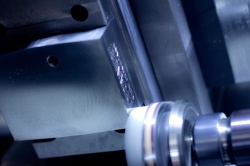
With a new advance in abrasive technology, machining center operators are now able to add surface finishing simultaneously in the same operation to speed things even further. For Eric Sun, Founder of Orange Vise Co., Calif., the unique combination of automated deburring and surfacing finishing allowed his company to eliminate several time consuming and laborious processes that had been slowing them down. The company manufactures CNC machine vises and quick change fixturing components using a Mori Seiki NHX4000 high speed horizontal machining center.
According to Sun, the company’s CNC machine vises are constructed of different materials and surface treatments. The body of the vise is made of cast iron with selectively hardened surfaces. The vise also comes with a variety of different sized with different heat treatments. The hardened surfaces, which could measure as high as 50-60 on the Rockwell C Scale, required grinding because milling cutters would wear out too quickly. Out of necessity, Orange Vise would also grind the non-critical, unhardened surfaces to create a uniform appearance over the entire workpiece.
“This process involved removing, cleaning, and then repositioning parts several times to be able to grind each face. It was time intensive, particularly for the work that was purely cosmetic,” explains Sun. Brush Research Mfg.’s new line of NamPower abrasive disc brushes allow CNC operators to automate the deburring process while delivering an ideal surface finish in the same operation.
“We started using the NamPower brushes for deburring, but quickly discovered they provided a really nice surface finish,” says Sun. Composed of flexible abrasive nylon filaments bonded to a fiber reinforced thermoplastic base, the NamPower abrasive disc brushes contain a unique combination of both ceramic and silicon carbide abrasive.
These abrasive filaments work like flexible files, conforming to part contours, wiping and filing across part edges and surfaces to deliver maximum burr removal rates along with an ideal surface finish. Other common uses are edge blending, part cleaning, and rust removal.
Although there are other abrasive nylon filament products that use silicon carbide or ceramic, it is the combination of both in one tool that makes it unique. The ceramic abrasive is responsible for material removal, but tends to cut a bit coarse. The silicon carbide acts as a buffer to the cutting action. The result is deburring and finishing in a single operation.
The NamPower brushes work well with non-ferrous, cast iron, mild steel and ductile iron, stainless and alloy steels, titanium, and high nickel alloys.
Orange Vise found the Dot style NamPower brush to be flexible enough to conform to features of varying heights and could be used on other parts as well. “We weren’t expecting to use brushes so much, but we’re finding more and more uses for them,” says Sun. “We use the same brushes for aluminum, steel, cast iron and several other materials without having to swap them out very often.”
One such application, and one of its primary purposes, is for edge blending.
Orange Vise uses a variety of deburring tools, including a 45 degree chamfer. Although the tool doesn’t typically leave a burr, when it begins to wear – even slightly – it can. Based on this potential, Orange Vise required an employee to inspect each part and handle any burrs by hand. Now the company automatically deburrs chamfered holes and edges using the NamPower Brush.
In addition, Sun says his company does some engraving on the vice jaws, using a ball end mill. Although the engraving on the underside of the vice does not require deburring, afiner engraving on the top was desired. A 45 degree V-bit that created burrs was used. The burrs were removed using the NamPower brush which were developed with tool longevity in mind.
The brushes are essentially “self-sharpening” over their life, as well. Because of its linear construction, sharp new grains constantly come in contact with the work surface and wear off exposing fresh cutting particles. This provides consistent deburring action throughout the length of bristles.
To eliminate filament smearing, improve surface finish and promote longer tool life, disc brushes are also designed with a new tool holder that allows coolant to flow through its center for better lubricant dispersion. This permits the brush to run at greater cut depths while reducing heat generation
More information:
Brush Research Mfg. Co.