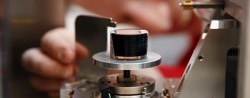
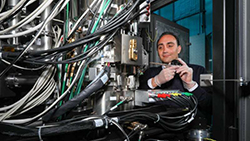
Researchers at University West in Trollhättan, Sweden, have invented a friction-stir-welding tool that also functions as a temperature sensor. The temperature is measured continuously and, if it becomes too hot, the heat is reduced by controlling the force and tool rotation. With the aid of an industrial robot and the temperature sensor, the researchers have been able to weld advanced three-dimensional joints. This enables the welding of small and more complex components with curved surfaces.
The robot welds with higher precision, and with the temperature controller, it takes only a few hours to program 3D joints. Manual programming of a similar component took up to a week.
The research project at University West was initiated through a collaboration between Volvo Aero, SAAB Automobile, and the welding equipment company ESAB.
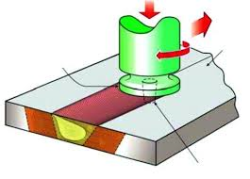
In FSW, a rotating non-consumable cylinder is pressed into the material. The combination of frictional heat and the mechanical “stirring” creates a high-quality welding joint, without melting the material. However, one of the problems with this method has been that if the temperature becomes excessively high, the metals can reach the melting point and the welding tool can sink through the sheets. To achieve good welds with a FSW robot, both the process forces and the temperature must be properly controlled.