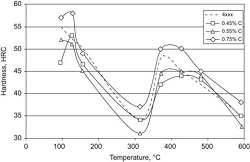
The term sinter hardening refers to a process in which the cooling rate experienced in the cooling zone of the sintering furnace is fast enough to transform a significant portion of the material matrix into martensite. The sinter hardening route has become increasingly popular due to its cost effectiveness.
Advantages of sinter hardening include:
- Eliminating secondary quench hardening treatment
- Better dimensional control due to less severe quench
- Elimination of retained quench oil in pores leading to fewer steps during tempering
- Oil does not have to be removed to perform secondary operations such as plating
Disadvantages of sinter hardening include:
- Difficult or impossible machining due to high hardness
- Need for tempering operation to relieve stresses and improve dynamic mechanical properties
- Impractical sizing or other secondary operations due to the high apparent hardness
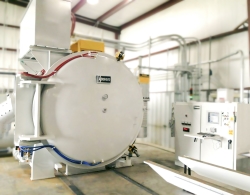
Cooling rate during sinter hardening can have a significant effect on final properties. While there are compositions that do not require any form of accelerated cooling to harden, there is still a gain in properties with faster cooling rates. Fans used to circulate the furnace atmosphere in the cooling zone increase cooling rate, and even faster cooling rates are achieved using a pressure gas quench.
For more information, click on the link below (subscription required). Then scroll to Figure 24.
Joseph W. Newkirk, Heat Treatment of Powder Metallurgy Steels, Heat Treating of Irons and Steels, Vol 4D, ASM Handbook, Edited By Jon L. Dossett, George E. Totten, ASM International, 2014, p 253-273, https://doi.org/10.31399/asm.hb.v04d.9781627081689