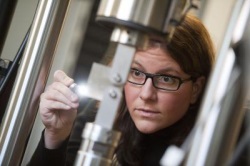
Worcester Polytechnic Institute, Mass., has received a three-year, $424,000 award from the National Science Foundation to support the development of a new way of manufacturing aluminum-ceramic composites to make vehicles lighter and more energy efficient. The award will support research by Prof. Diana Lados, ASM member and founding director of the Worcester Polytechnic Institute Integrative Materials Design Center.
The research will focus on ceramic-reinforced aluminum composites, which are produced by incorporating small ceramic particles within aluminum to enhance its strength and high operating temperature. Manufacturers would like to use these light composite materials in cars, trucks, boats, and airplanes to increase their fuel efficiency without sacrificing strength and ductility> However, current manufacturing methods cannot achieve the nanoscale size and uniform distribution of the ceramic particles necessary to fabricate parts that meet these requirements and perform well at both ambient and elevated temperatures.
With the NSF award, Prof. Lados will conduct fundamental and applied research aimed at developing a novel energy- and cost-efficient process for making nano-ceramic reinforced composites, overcoming the limitations of existing processes, and enabling the creation of materials with unprecedented combinations of beneficial properties and sustainability benefits.
“This project is another significant step in a large ongoing research program dedicated to developing novel materials and processes using a combination of fundamental materials science knowledge, property evaluations, and computational modeling,” Prof. Lados said.
Unlike current methods, in which the ceramic particles are mixed into the metal during processing, the new technique involves the formation of nano-reinforcements directly within the molten metal. The resulting composite materials will contain ceramic particles of the proper size, distributed uniformly in and firmly bonded to the metal matrix. Less expensive and more flexible and energy efficient than existing methods, the process can be used with a broad selection of metal-ceramic systems to manufacture a wide variety of structural components.