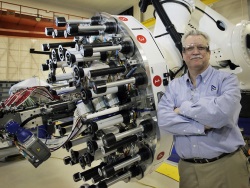
A robot named ISAAC, which features a versatile spinning head and a robust, acrobatic arm, will help NASA’s Langley Research Center, Hampton, Va., create and test new composite structures faster, less expensively, and with more room for experimentation than ever before. ISAAC stands for Integrated Structural Assembly of Advanced Composites. ISAAC can fuse ribbons of carbon fiber and epoxy into sheets of material following precise, sometimes curving patterns.
In recent years, carbon-fiber composite materials have proven their worth in aircraft such as the Boeing 787. Now, researchers want to improve them and expand their uses. Manufacturers take carbon fibers and combine them with partially cured epoxy resins to create narrow ribbons. These ribbons are the raw material used in many carbon-fiber composite materials.
In ISAAC’s case, the ribbons are loaded onto the robot’s rotating head where they can be fused together in sheets according to precise patterns, directions or arrangements, with as many as 16 spools of carbon-fiber ribbon. Those sheets are layered, one on top of the other, and eventually fully cured into one solid, durable mass.
ISAAC gives researchers more flexibility in arranging the ribbons and the fibers they contain. Conventional composites consist of many layers of fibers oriented at 0, 45, and 90 degrees. ISAAC can lay them down along a curving path, following a pattern designed to increase strength and performance.
“It changes how we look at composites,” said Brian Stewart, integration manager for the project. “It shifts the game, shifts the paradigm.” He said Langley has long maintained a vast array of technical skills and abilities in this area: concept development, analysis and simulation, sophisticated structural analysis. But when it came to building its own structures quickly, Langley was limited. ISAAC changes that.
Built by Electroimpact Inc., ISAAC is an adaptation of a KUKA standard industrial robot. One of its key features is a large, rotating, disc-like head. The head is typically loaded with as many as 16 spools of carbon-fiber ribbon. The head is not a permanent fixture, however. It can be detached and replaced with identical heads loaded with different tools. As a result, transforming the system to work on a new job can be fast.
“We can use these interchangeable heads for all sorts of amazing things — almost anything we can dream up,” Mr. Stewart concluded.