Advances by Linde LLC, New Providence, N.J., and Megamet Solid Metals Inc., Earth City, Mo. show that a best practice in the control of the carbon potential in the sintering zone can significantly improve the quality of metal-injection molded (MIM) parts. Improvements were achieved with an advanced SINTERFLEX Atmosphere Control System (ACS) from Linde. Using the system Megamet was able to reduce the standard deviation of carbon content in MIM parts, increase the number of parts in specification, eliminate rework/decrease rejects due to carbon content, and increase productivity.
“Homogeneity and consistency in the furnace atmosphere are pivotal to the success of MIM manufacturing,” explains Bruce G. Dionne, who co-chaired MIM 2014. “The highest accuracy carbon control is achieved by regulating the carbon potential at the sintering temperature to the value that will lead to the desired final surface carbon concentration in the sinter body upon cooling. The SINTERFLEX atmosphere supply system maintains the low CO+H2 concentration atmosphere necessary to stabilize carbon potential,” he says.
Dionne detailed findings on the Best Practice at the 2014 World Congress on Powder Metallurgy and Particulate Materials (PM2014) last June as General Manager of Megamet Solid Metals Inc. The PM2014 presentation, titled, “An Approach to Carbon Control of Sintering Furnace Atmosphere: Theory and Practice,” is published in Part 5 of the Proceedings of the PM2014 World Congress, available for purchase through the Metal Powder Industry Federation (MPIF). The paper also reviews the causes of decarburization and the dynamics of measuring atmosphere carbon potential.
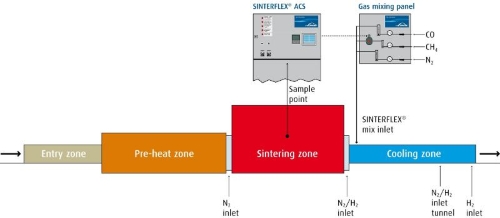
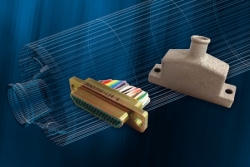
Megamet Solid Metals Inc. optimized the process at its MIM processing plant and improved consistency of carbon content for a higher percentage of parts in specification. Courtesy ofPRNewsFoto/Linde North America.
MIM offers a low-cost alternative to CNC machining, casting and other manufacturing processes, and can produce high-quality parts in volume, as well as for low-volume prototyping. The ability to produce complex shapes with superior strength and excellent surface finish make it ideal for many parts used in medical devices, electronics, tools and machines, and aerospace and automotive components.
The powder metal process combines the precision shape-forming advantages of plastic-injection molding with the strength and durability of metals. The final step in MIM is sintering, the high-temperature hardening process that fuses the high-density alloyed powders by applying heat below the melting point in a controlled atmosphere. By establishing a carbon-neutral atmosphere during sintering, MIM parts avoid decarburization, a frequent problem that prevents the carbon content from being in specification.