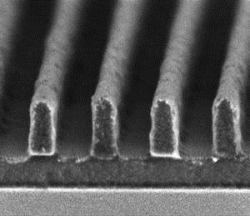
A research team at Northwestern University’s McCormick School of Engineering, Evanston, Ill., has investigated the behavior of silver nanowires under cyclic loading to advance the understanding of how they might function in flexible electronics. By varying the tension on silver nanowires thinner than 120 nm and monitoring their deformation, the team was able to characterize cyclic mechanical behavior.
“Cyclic loading is an important material behavior that must be investigated for realizing the potential applications of using silver nanowires in electronics,” Prof. Horacio Espinosa said. “Knowledge of such behavior allows designers to understand how these conductive films fail and how to improve their durability.”
They found that permanent deformation was partially recoverable, meaning that some of the material’s defects actually self-healed and disappeared upon cyclic loading. These results indicate that silver nanowires could potentially withstand strong cyclic loads for long periods of time, which is a key attribute needed for flexible electronics.
“These silver nanowires show mechanical properties that are quite unexpected,” Prof. Espinosa said. “We had to develop new experimental techniques to be able to measure this novel material property.”
The findings were recently featured on the cover of the journal Nano Letters. Other Northwestern coauthors on the paper are Rodrigo Bernal, a recently graduated PhD student in Espinosa’s lab; and Jiaxing Huang, associate professor of materials science and engineering at McCormick.
“The next step is to understand how this recovery influences the behavior of these materials when they are flexed millions of times,” said Dr. Bernal, first author of the paper.
www.mccormick.northwestern.edu