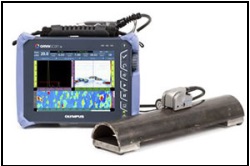
Olympus America, Waltham, Mass., developed a Dual Linear Array probe for corrosion inspection. It provides several advantages over conventional ultrasonic dual element transducers used with flaw detectors. It improves productivity through features such as larger beam coverage, faster scan speed, and C-scan imaging with increased data-point density. The pitch-catch technique of this new probe can offer better near-surface resolution and pit detection in corrosion survey applications than standard phase- array pulse-echo. The pitch-catch technology also improves the probability of detection of critical wall thinning.
The Dual Linear Array probe adds a new low-cost entry-level inspection capability to the existing Olympus HydroForm and RexoForm corrosion solutions, especially when combined with the OmniScan SX.
When using the probe with an OmniScan phased array instrument (PR or non-PR), the setup and operation is simple: load the setup file, check the calibration, and then inspect and record the data.
Installing an encoder on the probe gives the ability to generate C-scans on the instrument. An innovative probe stabilization system enables smooth data acquisition on piping surfaces as small as four inches in diameter. The typical inspection depth in carbon steel ranges from 1 to 80 mm.
Phased Array testing is a specialized type of ultrasonic testing in which sophisticated multi-element array transducers and powerful software steer high-frequency sound beams through the test piece and map returning echoes, producing detailed images of internal structures. It is used for inspection of critical structural metals, pipeline welds, aerospace components, and similar applications where the additional information supplied by phased array inspection is valuable.