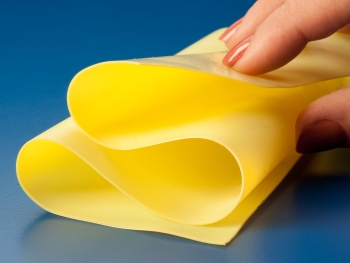
A new polyimide aerogel developed at NASA’s Glenn Research Center, Cleveland, represents a revolutionary advance over the fragile silica aerogels currently on the market. Glenn’s aerogel is 500 times stronger than conventional silica aerogels. Unlike current silica-based aerogel products that break down during handling and shed small dust particles, Glenn’s organic-based, cross-linked polyimide material is highly flexible and can be made into foldable thin films. This new flexibility further enables the commercialization of aerogels in the thermal insulation market.
The Technology Transfer Office at NASA’s Glenn Research Center signed a patent pending, exclusive license agreement with FLEXcon, Spencer, Mass. This exclusive license allows FLEXcon and its affiliate, Blueshift International Materials Inc., to manufacture and market Glenn’s patent pending polyimide aerogels for many aerospace applications such as insulation for cryotanks and spacesuits, as well as more down-to-Earth uses in construction, refrigeration and pipe insulation.
Aerogels are extremely low-density materials with excellent thermal and acoustic insulating properties based on their high porosity and small pore diameter. This makes them attractive candidates for many aerospace applications such as insulation for cryotanks and spacesuits, as well as more down-to-earth uses in construction, refrigeration, and pipe insulation. The main drawback that has prevented aerogels from having a broad commercial impact is their fragility.
All current aerogel products on the market today are silica-based, break down during handling and use, and shed small dust particles. Therefore, they must be encapsulated for most applications. In addition, insulation properties degrade over time as these small dust particles settle. In particulate form and within composite blanket, these aerogels have very little compressive or tensile strength and exhibit poor resistance to solvents. In addition, hydrophobic treatments that are necessary to keep the silica aerogel pore structure from collapsing in humid environments lower the thermal stability and cause out-gassing beginning at 350°C.
NASA Glenn sought to improve the mechanical properties of aerogels by reinforcing their nanoparticle network, especially in the neck regions between particles. NASA Glenn first accomplished this particle framework strengthening in 2006, resulting in polymer-reinforced aerogels. Use of these polymer-reinforced silica aerogels is limited by the type of polymer reinforcement used. Typically, use of the cross-linking polymers is limited to applications where temperatures are well below 200°C. Many aerospace applications require a higher temperature performance. In addition, though the polymer reinforced aerogels are stronger than conventional silica aerogels, they are still stiff materials. For many applications, and for easier installation/deployment, a flexible, foldable insulation is more desirable.
Polyimides are widely used as matrix resins for fiber-reinforced composites for aircraft engine applications because of their high-temperature stability. Organic aerogels made from linear polyimides have been reported, and while the mechanical properties for these aerogels are as good as previously reported polymer reinforced aerogels of similar density, they tend to shrink during the fabrication process because they do not possess a covalently bonded network structure.
How it works
The NASA Glenn team is the first to synthesize three dimensionally bonded polyimide aerogels by cross-linking through either an aromatic triamine or polyhedral oligomeric silsesquioxane, octa-(aminophenyl)silsesquioxane (OAPS) and chemically imidizing at room temperature. Gels formed from polyamic acid solutions of a variety of dianhydrides or diamine and the polyamine cross-link were chemically imidized using pyridine and acetic anhydride and dried using supercritical CO2 extraction to produce aerogels with densities ranging from 0.08 to 0.35 g/cm3.
These aerogels are 75-95% porous, have high surface areas (from 230 to 500 m2/g), and thermal conductivity as low as 14 mW/m-K at room temperature. Notably, the cross-linked polyimide aerogels have higher modulus than polymer-reinforced silica aerogels of similar density and can be fabricated as both monoliths and thin films. Thin films of these aerogels are flexible and foldable, making them ideal insulation for space suits, inflatable structures for habitats, and decelerators for planetary re-entry, as well as terrestrial applications. Thicker parts are stiff and strong.
With tensile modulus of 20-100 megapascal (MPa) and tensile strength of 9 MPa, the polyimide aerogel thin films are usable in automated equipment for wrapping around pipes. They are also flexible enough to be sewn into clothing and tents, layered into building materials, and molded into vehicle compartments.