When electronic devices overheat, they can slow down, malfunction, or stop working altogether. This heat is mainly caused by energy lost as electrons move through a material—similar to friction in a moving machine.
Most devices today use silicon (Si) as their semiconductor material. However, engineers are increasingly turning to alternatives like gallium nitride (GaN) for longer lifetime use and higher performance. This includes products such as LEDs, compact laptop chargers, and 5G phone networks.
For even more extreme applications—such as high-voltage systems or harsh environments—researchers are exploring ultrawide bandgap (UWBG) materials like gallium oxide (Ga2O3), aluminum gallium nitride (AlGaN), and even diamond.
The key difference between these materials lies in their electronic bandgap—the energy needed to get electrons to flow through the material. Wider bandgaps allow companies to reduce the size of their electronics and make them more electrically efficient.
“UWBG materials can resist up to 8,000 volts and can operate at temperatures over 200°C (392°F), making them promising for the next generation of electronics in the energy, health, and communication sectors,” explains Georges Pavlidis, assistant professor of mechanical engineering at the University of Connecticut (UConn).
While these materials offer promising advantages, they also come with challenges. They’re currently expensive, difficult to manufacture, and their thermal behavior is hard to measure precisely. As electronics become more powerful and in smaller dimensions, the heating in the device becomes more localized and can generate a heat flux greater than the sun, Pavlidis explains.
“Chip manufacturers need new methods to measure temperature in smaller dimensions,” he says.
Pavlidis, along with UConn’s School of Mechanical, Aerospace, and Manufacturing Engineering Ph.D. candidates Dominic Myren and Francis Vásquez, collaborated with colleagues from the U.S. Naval Research Laboratory over the past year to tackle the challenge of measuring the heat output. Their work resulted in a “Perspectives” paper published in Applied Physics Letters.
In the article titled “Emerging Thermal Metrology for Ultrawide Bandgap Semiconductor Devices,” the co-authors discuss the pros and cons of using UWBG material for semiconductors, and outline several innovative techniques for measuring temperature at the microscale. These methods could help engineers design faster, more powerful electronic devices—without the risk of overheating.
In the paper, the researchers explore several options for measuring temperature in UWBG devices. They suggest using optical methods like Raman spectroscopy and thermoreflectance, which use light to measure temperature-dependent properties. Electrical methods use electric signals to detect temperature, and scanning probe methods, like scanning thermal microscopy, touch the surface to feel the heat.
The researchers also describe exciting new ideas, such as combining thermal images created from different colors of light to see heat in nitride-based devices, or measuring how light is absorbed in material defects to calculate the temperature in gallium oxide electronics. They’re even working on a new kind of microscope that can see very tiny heat patterns using deep ultraviolet light.
“These proposed methods provide a solution to measuring the peak temperature in future electronics, which is the primary indicator of when the device will fail. Providing the industry with accurate metrology will lower the barrier to commercialization and enable engineers to develop new thermal management strategies,” Pavlidis says.
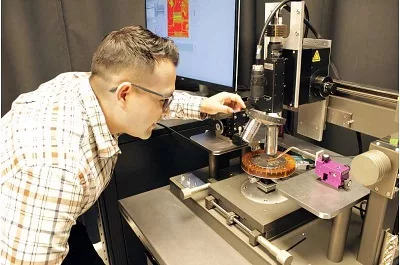
Image – UConn’s School of Mechanical, Aerospace, and Manufacturing Engineering Ph.D. candidate Francis Vásquez uses a thermoreflectance imaging system to measure temperature in a transistor. Courtesy of: Sarah Richmond/UConn.
For more information:
University of Connecticut
https://uconn.edu/