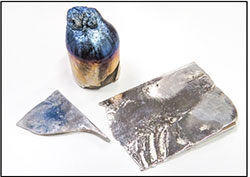
Australia’s University of New South Wales (UNSW) announces that a research team has developed a method for predicting the combinations of metals that can form metallic glass alloys The method has enabled researchers to successfully predict more than 200 such alloys based on magnesium, silver, copper, zinc, and titanium. The photo shows magnesium-based bulk metallic glass castings.
The team includes Prof. Kevin Laws and Prof. Michael Ferry of the UNSW School of Materials Science and Engineering, and ASM Fellow Dr. Daniel Miracle, Chief Scientist in the Materials and Manufacturing Directorate of the U.S. Air Force Research Laboratory.
They describe the method in “A Predictive Model for Metallic Glasses,” published Sept. 15 in the journal Nature Communications. Here is the abstract:
“Great progress has been made in understanding the atomic structure of metallic glasses, but there is still no clear connection between atomic structure and glass-forming ability. Here we give new insights into perhaps the most important question in the field of amorphous metals: How can glass-forming ability be predicted from atomic structure?
“We give a new approach to modelling metallic glass atomic structures by solving three long-standing problems: we discover a new family of structural defects that discourage glass formation; we impose efficient local packing around all atoms simultaneously; and we enforce structural self-consistency.
“Fewer than a dozen binary structures satisfy these constraints, but extra degrees of freedom in structures with three or more different atom sizes significantly expand the number of relatively stable, ‘bulk’ metallic glasses. The present work gives a new approach towards achieving the long-sought goal of a predictive capability for bulk metallic glasses.”
The new structural model predicts the most stable binary metallic glass topologies, which allows scientists to predict the metal combinations that will have glass-forming ability.
“We will also be able to engineer these materials on an atomic scale so they have the specific properties we want,” says Prof. Laws. “We can start to create many new useful metallic glass types and begin to understand the atomic fundamentals behind their exceptional properties.”